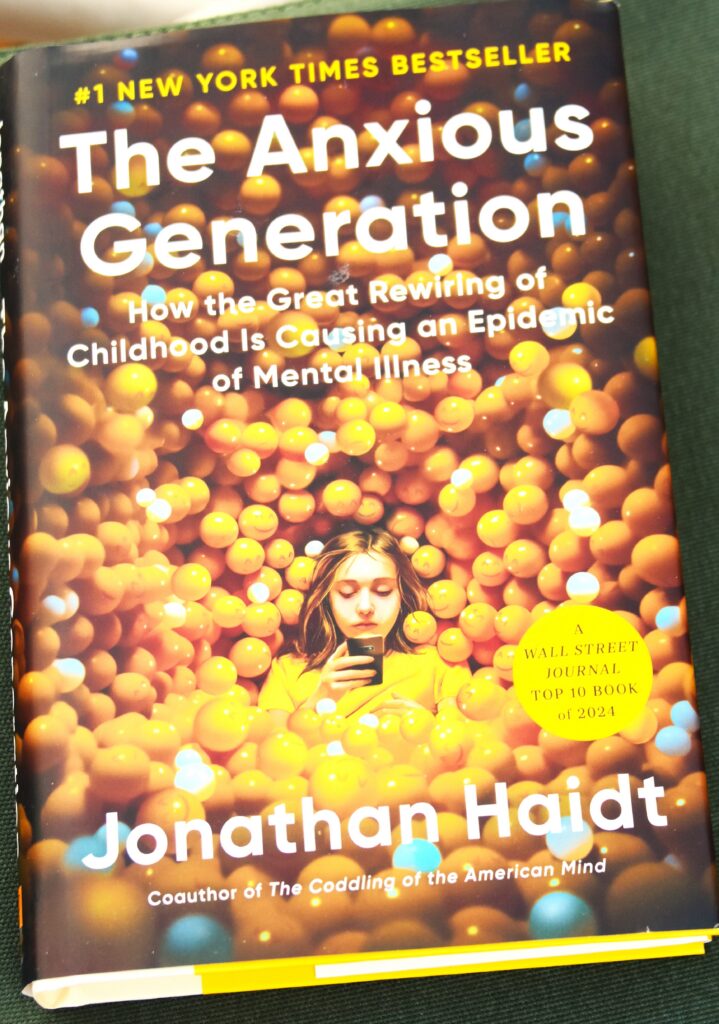
Jonathan Haidt, The Anxious Generation: How the Rewiring of Childhood is Causing an Epidemic of Mental Illness, New York: Penguin Press, An Imprint of Pnguin Random House LLC, 385 pages, Hardcover, $30.00, Canada $39.99 (ZK577.48)
BOOK REVIEW
by
Mwizenge S. Tembo, Ph. D
Emeritus Professor of Sociology
Introduction
Since our evolution and migration from the African vast Savannahs a hundred thousand years ago, we humans or homo sapiens have been exceptionally good at not just survival but we have thrived. Our young are born small, fragile, very dependent and vulnerable with an outsize big head. As we grow, we walk, learn speech, culture, and often do not reach full maturity and become fully grown responsible humans in all societies until the age of 25 when our frontal cortex of our brain is believed to be fully mature and functional.
Through all the ecological, environmental, and technological changes, we humans made sure teaching, raising them, and learning by our children was best done in the real world in groups with others. In fact not only communities and parents over thousands of years have identified best ways to raise our children, many psychologists like Jean Piaget for example, identified 4 stages of sequential human development; sensorimotor, preoperational, concrete operational, and formal operational which are driven by growth, maturation and experience. It was taken for granted that all this cognitive development happened in the real world. Something however happened two decades ago.
This reviewer is over 70 years old whose childhood goes back to 1959 growing up in the village in Zambia Africa. He and perhaps billions of other people were enjoying growing up developing their 4 stages of cognitive development.
Fast forward to 2026. This reviewer just finished reading both the fascinating and alarming Jonathan Haidt, The Anxious Generation: How the Rewiring of Childhood is Causing an Epidemic of Mental Illness. Haidt argues in the book that since the evolution of human beings or homo sapiens over 100 thousand years ago in the plains of Africa, we survived because we raised our children outside in the natural real world and lived in very specific ways as communities. Children played together outside in the real world. Peers, parents, teachers, schools, and communities taught them social skills that eventually helped the children to become adults and become happy successful well-adjusted members of the communities. This pattern of childhood never changed much even during all the technological changes, especially after the Industrial Revolution in Europe that spread all over the world.
According to Haidt, the widespread introduction of smartphone cell phone technology changed drastically the experiences of childhood. There has been a serious rewiring of childhood. Perhaps millions of children have had exclusively phone-based childhood. “The most intense period of this rewiring was 2010 to 2015”. (p.4)
Haidt describes the four “foundations harms of the new phone-based childhood that damage boys and girls of all ages: social deprivation, sleep deprivation, attention fragmentation, and addiction.” (p.114)
Haidt explains and devotes 385 pages of the substantial portions of the book articulating alarming details of the four harms of the phone-based childhood. Towards the end, he recommends four urgent solutions: “First, No smartphones before high school. Second, No social media before 16, Third, Phone free schools Fourth, Far more unsupervised play and childhood independence.” (p.290)
My reading of “The Anxious generation” happened at the worst or best time depending on your perspective. I flew ten thousand miles or 16 thousand kms to Zambia in Southern Africa. I lived in Lusaka, the capital city of Zambia for a few weeks. I travelled by bus to the most remote villages of rural Africa in the Eastern province of Zambia. My observations, experiences. the verdict was the same: the cell phone is changing the lives of not only the young generation but even the normal everyday lives of adults seem to be severely disrupted. The reader probably thinks this reviewer is engaging in hyperbole or fear mongering, worst he is old and conservative. The reader may argue “Social media after all has never been so good and popular especially with the coming AI. Isn’t all this technology great?”
“The Anxious generation” suddenly provided me with answers to what I experienced in 2018 after I had been teaching undergraduate students for 41 years. When I walked into the class of 30 students, the class was quiet with everybody’s head down staring and swiping at their smartphones. Previously students would talk to each other and there was always noise before I started the class. I used to say: “Class can you stop talking! The lecture starts now!” This time I was saying: “Class put your cell phones away!” Students no longer talked or argued with each other during class when I raised an obviously provocative question. There was complete silence. I did not know how to explain the silence at the time.
One particular small class of 14 students surprised and disturbed me in 2018. During that semester, the students were always very tense, nervous, and anxious about nearly everything in class; tests, assignments, aspects of my lectures that I had successfully given for the previous 28 years. During the last day in this one particular class, 2 students actually were exhibiting signs of an emotional meltdown. I had not changed. I could not understand why all of this was happening to my students. Other faculty members at the time said the same things. They said the students were very anxious, depressed, and incurious.
According to Hardt, these are the serious symptoms of children who have been raised on cell phones while totally cut off from significant learning and socializing experiences of the real world. This reality ought to alarm everyone. But I am not sure if this alarm has happened or will happen at all in this environment in which nearly everybody seems seriously distracted by the cell phone technology.
I would recommend this book to everyone, even those who have extremely short attention spans, preferring 2-minute reads from social media. If we do not pay attention to and solve this existential threat or problem, most of the 8 billion people may seriously be in danger of extinction. We, the entire humanity, have never experienced or been confronted with this existential threat to the core of our very lives both as individuals and especially as societal groups.