by
Mwizenge S. Tembo, Ph. D.
Emeritus Professor of Sociology
If you grew up like I did 70 years ago at Chipewa Village in the Eastern province rural Zambia in Southern Africa, you have certain deep life experiences. These experiences exist buried deep in my soul for the rest of my life. This has been both a great blessing but also a burden. If you live more than 30 years in the Western world, you gradually lose your soul. Your body and mind yearn to reclaim or re-experience the connection to the soil and the soul to the African natural wilderness. This part of your soul might be less understood today by some of the 19 million young Zambians who live in the modern world. These young Zambians may have now joined their counterpart Western young people who live on the cell phone. Why am I saying all of these strange things?
I was flying home from the United States recently when these yearnings of the soul overwhelmed me. Massive engines of the Airbus 380 hauling more than 500 passengers toward home to Africa fiercely roared all night under my feet like a dozen hungry lions. I was served a snack, ate dinner, slept, woke up, slept again, when I woke up it was dawn. Each hour crawled slowly. I ate breakfast and my feet were about to step on my Africa old sweet home soil at sunrise after 17 grueling hours.
The excitement and rush of adrenaline doesn’t get old when the plane kisses the ground and you land at Kenneth Kaunda International Airport in Lusaka in Zambia. You walk out of the terminal exhaling and knowing you are home free to roam the streets and the land of perpetual sunshine and blue skies. People build and love to own mansions and villas with swimming pools. My soul is different.
This is why my farm caretaker Mr. Phiri thought I was crazy. I arrived at my personal model village with real traditional village grass thatched huts in Chongwe in rural Lusaka. As soon as I stepped out of the taxi, I decided to walk on my 2 bare feet on bare earth for the whole period of days when I was walking on the village paths. A Nya Banda, the wife of Mr. Phiri, just shook her head when she saw my pale bare feet step on the bare brown rough ground. I walked first very gingerly. I do not advise any readers in 2026 to try walking barefoot while in any part of the rural bush in the African village.
Visit to Wildlife Camp
This was pure happenstance or serendipity. I was on my laptop in my RB&B in the capital city of Lusaka when I impulsively casually typed the search for something like: “South Luangwa Safari lodges”. I found out within minutes that April was before the peak dry season of tourism that starts from May to November when prices skyrocket and are prohibitively high. The flights and lodges were rock bottom cheap now in April. I am not rich. What I always do is that if rich and well-off people throw scraps of food to the ground from their table, I pick up the scraps and create a good, delicious meal for myself. I have stayed cheaply in so many expensive luxurious places when it is off season for tourism that I have had great experiences. My heart was already pumping with excitement as I thought and fantasized about staying at the Wildlife Camp in the South Luangwa Game Park again after 14 years when I was last there.
History
If you have great memories and a deep love for a place, be it your home neighborhood, your former school or college, beach vacation resort, there is always a history of how you fell in love with the place. Twenty-six years ago in June 2000, I took my two American young sons, 11 and 15, to visit their village in Lundazi in the Eastern Province. My late uncle had given us his old pickup truck to use. Predictably it developed some mechanical problems. After visiting their grandparents (my parents) and dozens of relatives, we were to visit the Luangwa Game Park.
We arrived in Chipata with no reservation for any of the safari lodges or camps. It was late in the day and I had topped up the gas tank at the petrol or gas station near the Chipata-Lundazi road junction. I was pacing frustrated and not knowing what to do. I saw a white man walking by.
“Sir!” I stopped him. “My 2 boys and I would like to go to a safari lodge in the Luangwa Game Park. I never made any reservations. Do you know any safari lodge I would go to right now.”
“You are talking to the right person,” he replied. “I am Herman Miles, the owner of Wildlife Camp. If you leave now, which is about 4 pm, you would arrive there at 6:00pm. I can call my wife and the camp chef to tell them you are coming and to have food ready for you when you get there. Tomorrow you can go and see all the animals you want.”
I jumped into the pickup truck.
“Boys!!!” I yelled. “We are on our way to the Wildlife Safari Camp!!”
The road from the Chipata Provincial town to Mfuwe in the Luangwa Game Park was still unpaved at the time. The pickup truck bounced around, vibrated, and shook as if it was going to disintegrate. At one point we hit a huge bump that bounced the boys so high that their heads almost hit the ceiling of the cabin of the truck.
“Hang on boys!!!” I yelled above the loud noise. “We will get there!!!” I glanced at them and I could see they were smiling and probably telling themselves; “This is too thrilling to be happening, Adventure!!!!”
After 2 hours we arrived at the Wildlife Camp. It was dark. We ate dinner. Everything I experienced, and the vibe of the place was magical that one day and two nights. At about 2am at night we heard lions roaring in the distance as we were sleeping in our chalet.
April 2026
I boarded the 30 passenger two propeller Hawker Siddeley that was to fly an hour to Mfuwe. There were only 7 passengers on board, and the flight only took 45 short minutes. We landed at sunset. I was so excited I rushed through the small arrival gate and immediately saw one of the arrival hosts holding a sign “Wildlife Camp”.
“Wildlife Camp!!” I yelled. “So glad to see you!” I shook the guy’s hand and hoisted my carryon backpack onto my back. We arrived at the parking lot, and he pointed to his 4-wheel drive SUV vehicle which was to take us to the camp.
“Do you have any other bags?” my host asked.
“Ohhh!” I shouted, slapping my forehead, “I have a bag. I am so excited I forgot about picking up my bag first.”
We returned to the tiny arrival lounge and picked up my bag which had large lenses, cameras, and other photographic equipment.
When I see anything, meet anyone significant, an event, or see wild animals on a safari, I believe I have to use all of my God given senses being present in the moment; smell (nose), seeing (eyes), hearing (ears), touch, (skin) and taste (tongue). This sounds easy until you realize today that we live in a world where most people are glued to the cell phone. How can anyone truly experience anything if the first thing you do is to stick your cell phone in front of your face practically always when you are trying to experience something special and exciting? This is why I judiciously use only my still camera.
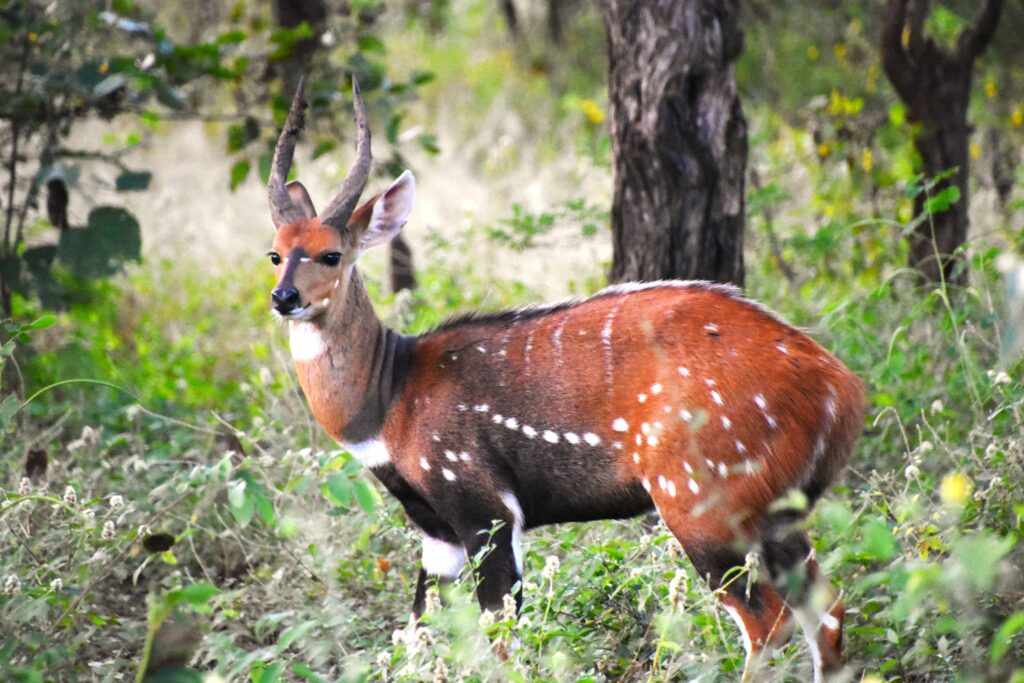
During that one day, everything I saw and heard was magical and great for my soul. We saw and heard numerous animals and birds in their natural habitat. This is why I never really enjoy going to the zoo because once you see animals up close in nature, you feel sorry for zoo animals.
Highlights
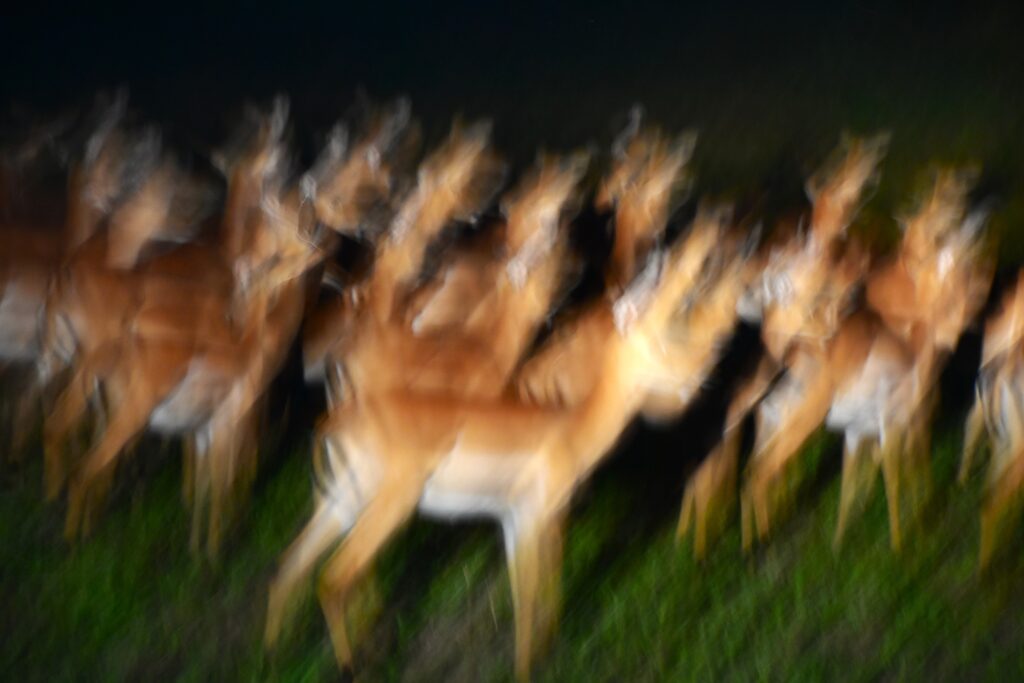
I saw numerous animals. I have chosen only the top 2 highlights during our safari. We were sitting under a large tree taking a tea break during the morning safari drive when the Njiba bird landed in the tree above us and began crooning and singing. The Njiba bird sound in my view is the signature bird song of the Savannah Africa wilderness. I have even tried to convince my fellow church congregation members at Harrisonburg Unitarian Universalist church (HUU) in Harrisonburg in Virginia. I was audio recording the bird, when all the 50 impalas who were grazing near us raised their heads, froze and intensely stared toward one far direction. At the same time, the baboons and monkeys nearby made squealing alarm sounds. Something was up; it was happening, those were the signals of danger and urgency in the natural world around us.
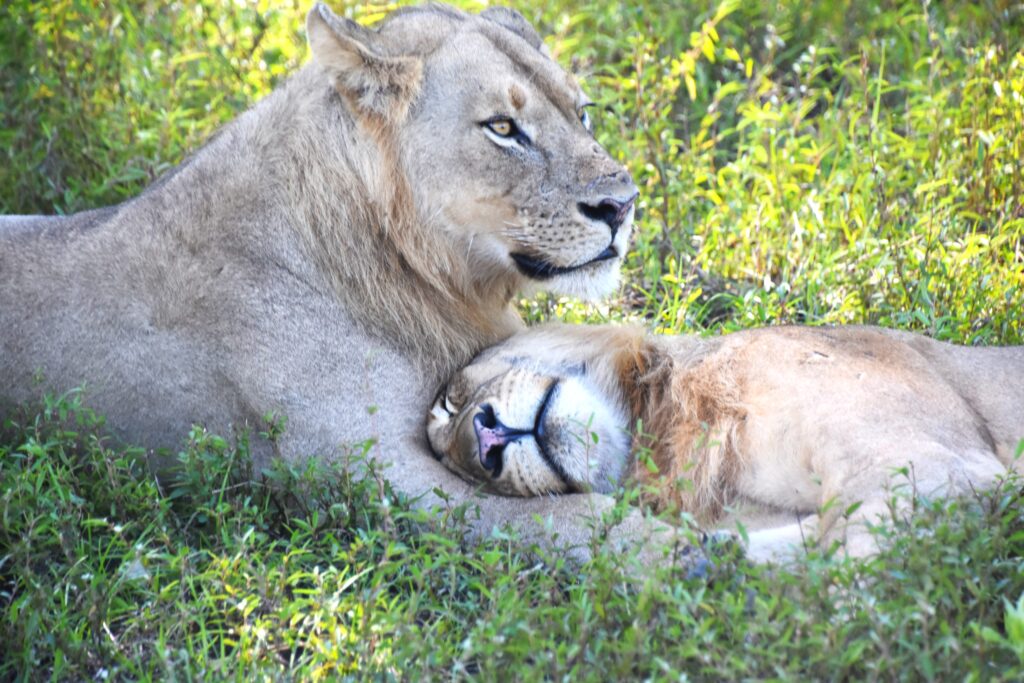
“I can see maybe 2 or 3 lions!!” Joyi, our safari guide, yelled pointing to the far side of the meadow where the impalas were all nervously looking toward with their ears perked and tails swiftly wagging side to side. At a distance of one mile or 1.6kms. One lion just emerged from the underbrush and joined others under the shade of the tree.
“We have not seen any lions here in the Park for 3 weeks. We are lucky,” Joyi said. The chase was on. The safari guide could not drive his tough Land Cruiser across the meadow as it had just rained heavily 2 days before. There was a foot deep of swamp water in which the jeep was going to sink and be stuck. Joyi had to drive around the far drier side to get to the tree. He reached for his cell phone and immediately began to excitedly alert other safari parties that lions had been spotted.
We finally drove right next to about 20 feet or 6meters of the 3 lions who completely ignored us. One of them was fully carefree asleep. The lions were not afraid of us.
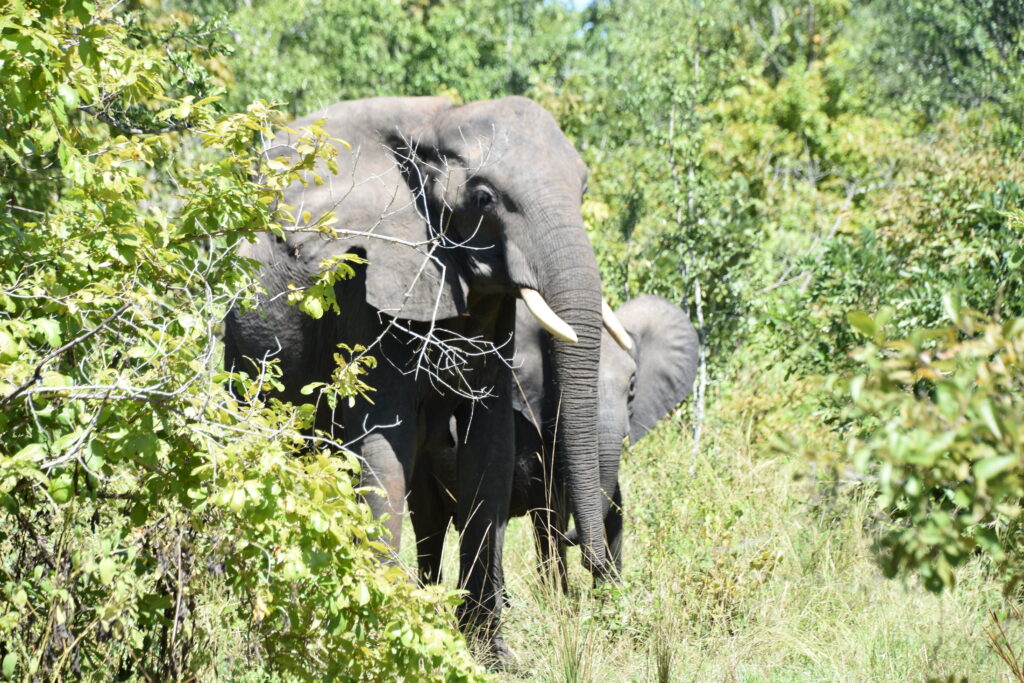
The second highlight is when we spotted 5 elephants. They hid behind the tall bushes and Joyi, our safari guide, knew exactly what to do. He maneuvered the jeep safely up to as close as 100ft or 30meters. That’s when I noticed that the elephants were caked in fresh black wet mud. There was a strong stench and a swarm of insects buzzing and circling around the elephant including tsetse flies, one which bit me. The baby elephant raised its small trunk as it was mimicking its mother who was raising her trunk immediately producing that shrill loud piercing sound. I just sat there in awe of that moment. In between my gazing, I hit my photographic camera shutter making those rapid sweet licking sounds of urgency while trying to catch and freeze some actions.
At the Wildlife Camp you have to be escorted to and from your Chalet to the dining room although the distance between your chalet and the dining room is perhaps 50meters or 164ft to 80 meters or 262ft. This is because there are bushes and wild animals are always wandering around because the camp is their natural domain.
An hour before being driven to the airport after breakfast in the morning, I sat in front of the dining room which faces the majestic meandering mighty Luangwa River. It was sunny with a blue sky. I saw and heard the hippos. The Njiba, Munthyengu and other birds sung above me in the trees. The monkeys were making faces at me. I got very emotional that I was leaving this majestic, soulful, beautiful and wonderful place that is the unique Wildlife Camp. Zambia, my Zambia is truly a country of honey and milk. Why do good moments end?