Secondary Education: Where are they Now?

by

Mwizenge S. Tembo, Ph. D.

Author of “Satisfying Zambian Hunger for Culture”.

Professor of Sociology

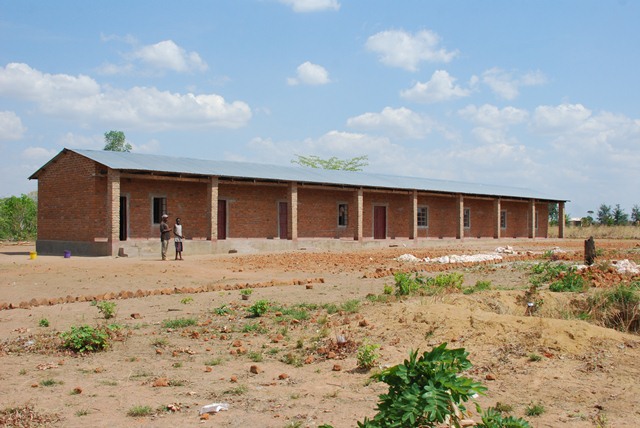
The Zambia Knowledge Bank Libraries: Nkhanga Branch (ZANOBA) in Lundazi in the Eastern Province of rural Zambia was at the very crucial beginning of its construction in March of 2007. A few dollars had been donated by private citizens in Bridgewater in Virginia in the USA toward the construction of the library. A few men in the village had molded bricks and cleared the bush to begin the digging of the foundation. But there was a serious hitch that threatened to derail the project. There was no professional architect to draw the plans for the building. Any professional architect was going to demand an estimated  Ninety million Kwacha. The project was not going to have that kind of money in a million years as it was going to be always at the mercy of small individual community donors and volunteers.

Drawing Building Plans

As I was about to sleep agonizing over the serious problem, it suddenly hit me. I had taken a technical drawing class when I was in Form V (Grade 12) at Chizongwe Secondary School  36 years before in 1971. I could use that skill to plan and make the drawings that the builders could use when constructing the massive library. I got hold of a mathematical set box with 45 and 60 degree set squares, compass, 180 degree protractor,  a stencil, a pencil,  a ruler, and a piece of paper. Once I finished the drawings, I gave them to the foreman on the construction site. As the saying goes, the rest is history. I still cannot believe that I drew the plans of the massive sturdy beautiful building  when it was officially opened as a library with more than three thousand books on December 8, 2012. How could an untrained sociologist make effective technical drawings for a building?

http://www.bridgewater.edu/zanoba/

https://www.youtube.com/watch?v=TYtuGF075dk

The magnificent library building show that you can use even good secondary or high school knowledge to solve life problems.

The magnificent Nkhanga  library building shows that you can use even good secondary or high school knowledge to solve life problems.

The answers to this question  has to do a lot with not just education but the value of certain forms of secondary school education. All of this came to my mind when I was looking for a family  photograph in an old photo album when two secondary school photos suddenly dropped to the floor. This was very fortuitous as I stared at the old black and white photos from Chizongwe Secondary School.

Photo of the Teachers

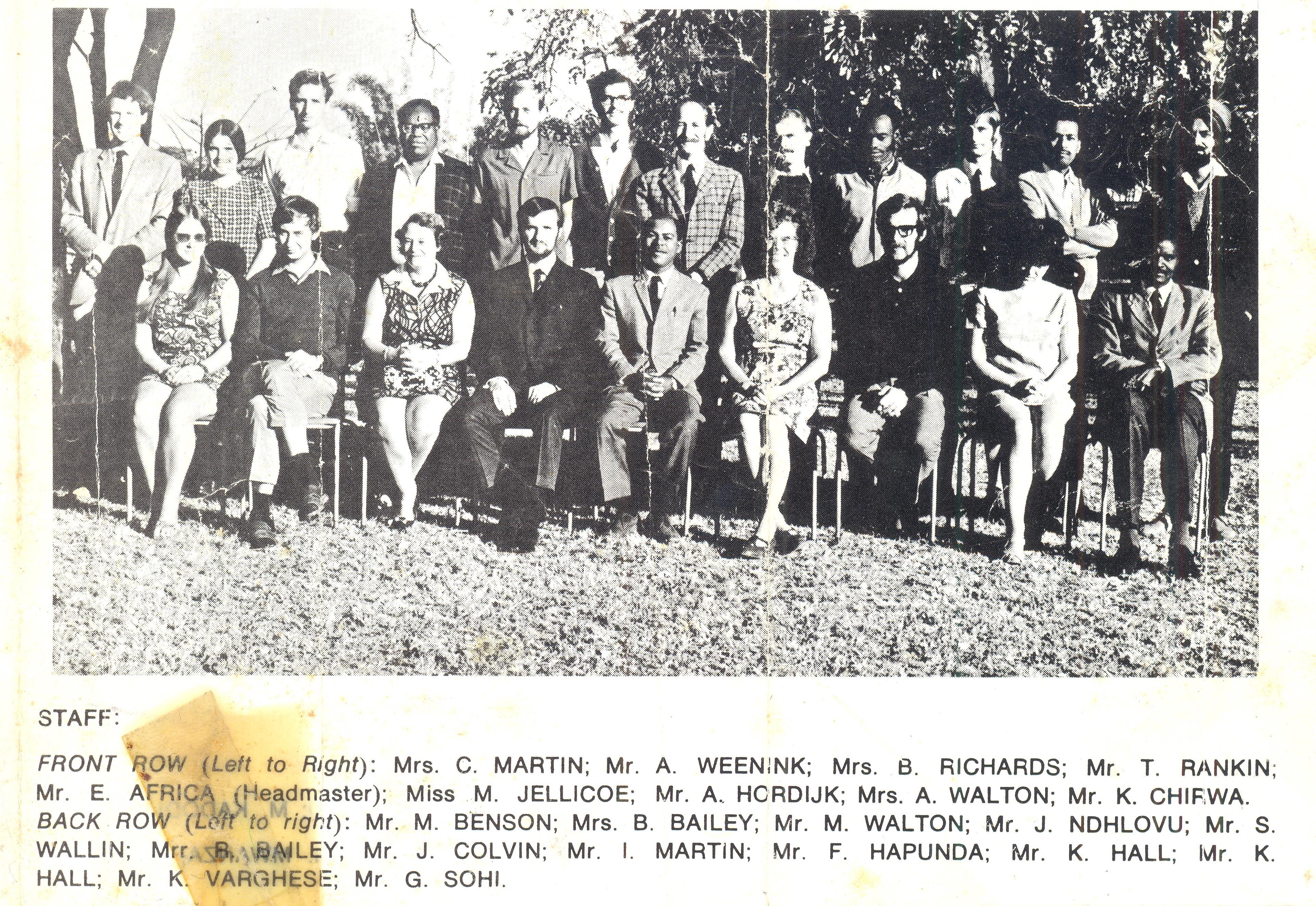
One photo had all the 22 teachers most of whom were Europeans. There were only 3 Zambians. This was just 6 years after Zambia’s independence and the Zambian government had a massive program to produce educated citizens to fill skilled jobs. In 1964 at Independence, “Zambia had only 100 Zambians with University degrees, about 1500 Zambians with Form V or Grade 12 school certificates, and only 6,000 with junior or two years secondary education.  There was a critical shortage of manpower which could also be called a crisis for a country that had an urgent need to achieve high levels of development.” (Tembo, 2012: p. 334) The British colonialists had left practically no skilled  man power to run and develop the country. The teachers were kind and did a great job.

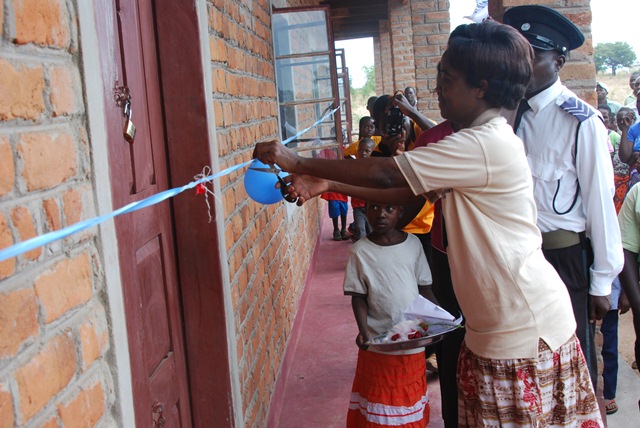
Ms. Janet Mvula, the Lundazi District Commissioner cuts the ribbon durinng the official opening of the Nkhanga (ZANOBA) library on December 8, 2012

Ms. Janet Mvula, the Lundazi District Commissioner cuts the ribbon durinng the official opening of the Nkhanga (ZANOBA) library on December 8, 2012

Mr. Hall was my technical drawing teacher who demonstrated how to bring to life all the lines on a piece of paper to a live building. Mr. Africa was the Headmaster. Mr. Benson introduced me to English Literature reading the classics Chinua Achebe’s “Things Fall Apart” “Julius Caesar”, and “A Man of All Seasons”. I came to love reading so much that I went on to buy and read most of Charles Dickens books. I own an entire Charles Dickens collection. Mr. Sohi from India wore a turban and introduced me to basketball on the dusty school basketball yard court although I was one of the least athletic people in the world.

Mr. Ian Martin was the world history teacher whose ideas about world wars I can still apply to international wars to day. What I gained from his class was very valuable although I has a poor score of 8 in History in my Form Five G.C. E. Exam. We nicknamed him “Mr. Tinadall” after the author of the World History Textbook. Mr. Hordyk from Holland introduced me to Math that I love up to this day. He introduced and reinforced in me the spirit of volunteerism as I worked with him in Chipata Nutrition Group to fight malnutrition. Most of the teachers were from United Kingdom and Canada.

Zambian Teachers Inspirational models

The Zambian teachers were very inspirational models. Mr. Hapunda was a young dashing teacher who had just come out a teachers’ training college. He taught the Ballroom Club that travelled to St. Monica’s Seconadry school and St. Francis Nursing School to dance ballroom.

Teaching Staff at Chizongwe Secondary School in 1971. The teachers did a great job.

Teaching Staff at Chizongwe Secondary School in 1971. The teachers did a great job. Where are they now?

Mr. Chirwa taught me not only spoken but also written Nyanja or Chichewa. Knowing and mastering Chichewa or Nyanja and all Zambian languages is so important as Bantu languages may be the foundation of all human language to day. We Zambians and Africans or Bantus are origins of all human civilization going back two hundred thousand years ago even going back to the Pharaohs about three thousand years ago. Fergus Sharman supports this perspective in “Linguistic Ties between Ancient Egyptian and Bantu: Un covering Symbiotic Affinities and Relationships in Vocabulary.”

The Importance of  Students and Teachers

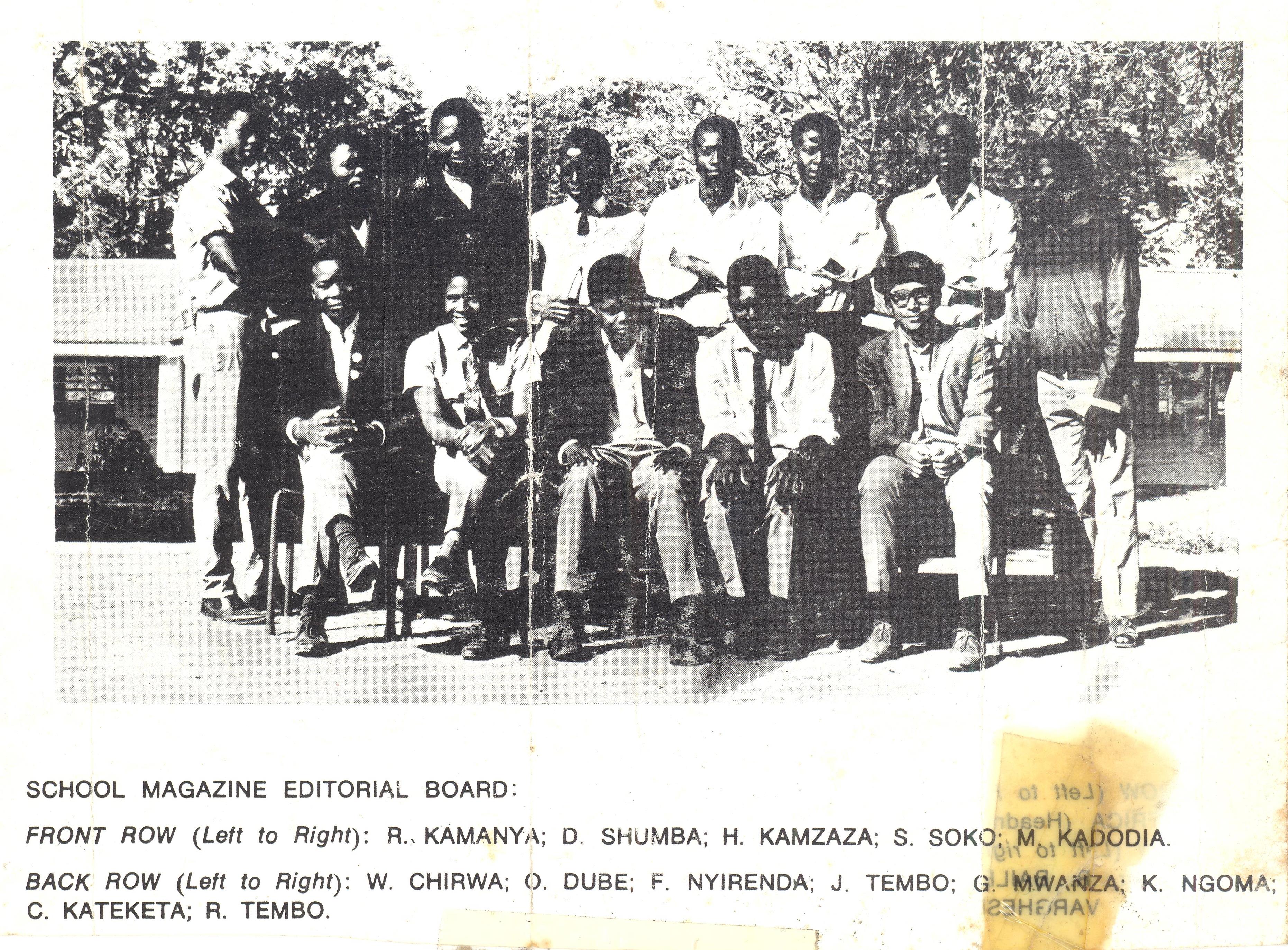
The photo of the Chizongwe Secondary School Magazine Editorial Board shows many close friends such as Weston Chirwa, Kennedy Ngoma, Simon Soko, Mussadique Kadodia, Dickson Shumba, Richard Kamanya. I have always regretted that I never met the late Charles Kateketa again after July 1975 when were both at University of Zambia as students.

The Editorial Board of the Chizongwe Secondary School Magazine in 1971. Where are they now?

The Editorial Board of the Chizongwe Secondary School Magazine in 1971. Where are they now?

Secondary education may be the foundation of not only education but also the future character of a student. Teachers play a crucial role in gaining the education as well as establishing one’s character and integrity. We all owe our secondary school teachers and friends great appreciation.

St. Monica’s  Secondary School Girls

One positive influence that may not seem obvious is that every young man needs to have positive relationships with girls very early in life. The positive influence that St. Monica’s Girls Secondary School had on most Chizongwe boys cannot be over emphasized. The influence was so powerful that one student wrote a very powerful poem that was published in the student magazine that year serenading the love and dedication Chizongwe Boys had for  St. Monica’s girls even in the boys’ dreams. What would be life without all these influences?  But what I keep wondering is where are all these people now that had such a big influence on my life?

References

Sharman, Fergus., Linguistic Ties Between Ancient Egyptian and Bantu: Uncovering Symbiotic Affinities and Relationships in Vocabulary, Boca Raton, Florida: Universal-Publishers, 2014.

Tembo, Mwizenge S., Satisfying Zambian Hunger for Culture,  Xlibris Corporation, 2012.

High Price: Book Review

By

Mwizenge S. Tembo, Ph. D

Professor of Sociology

Dr. Carl Hart, High Price: A Neuroscientist Journey of Self-Discovery that Challenges Everything You Know About Drugs and Society, New York: Harper Collins, 2013, pp. 340, $26.99, Hardcover.

Introduction

Whether you consider yourself an ordinary reader, a well-read citizen of the global world, a highly educated individual who is a Ph. D. holder in the specialized reified air of natural or social sciences in the highest echelons of academia, there is no book that you will read that may result into driving a seismic shift in existing epistemologies and paradigms. This is not mere hyperbole to sweeten the selling of a book. Reading this book gave me the same feeling I had when I first read “The Death of White Sociology” (1973)  by Joyce Ladner thirty-seven years ago when I was a young graduate student. It was the realization that what had been published in respectable academic literature up to the 1920s in America and the Western world as “objective” scientific studies that reinforced deeply racist foundations of Western culture was actually debunked by Ladner as being deeply flawed. The basic foundations of the racist views have not been eliminated since the publishing of that book by Joyce Ladner.

Is this also about to happen to Dr. Carl Hart’s work? Are most readers going to dismiss the book and therefore its powerful new ideas as mere usual grievance ideology to make whites feel guilty about racism and African-Americans and so-called minorities to feel righteous?

High Price and Color Blind Society

Dr. Carl Hart’s High Price: A Neuroscientist Journey of Self-Discovery that Challenges Everything You Know About Drugs and Society, is a story of the most unlikely African American man to become a neuroscientist. He grew up in poverty in a violent dislocated family in the toughest neighborhoods of Miami. But he fought too many odds to become someone least likely to be so: a neuroscientist and tenured Assistant Professor at the prestigious Ivy league Columbia University. So this is a story of an individual rising from rugs to riches, so what? There are perhaps thousands in if not millions of Americans who beat various types of odds and obstacles to achieve the highest positions in the professions they have decided to pursue. What is different about Dr. Carl Hart’s ideas, experiences, and biography?

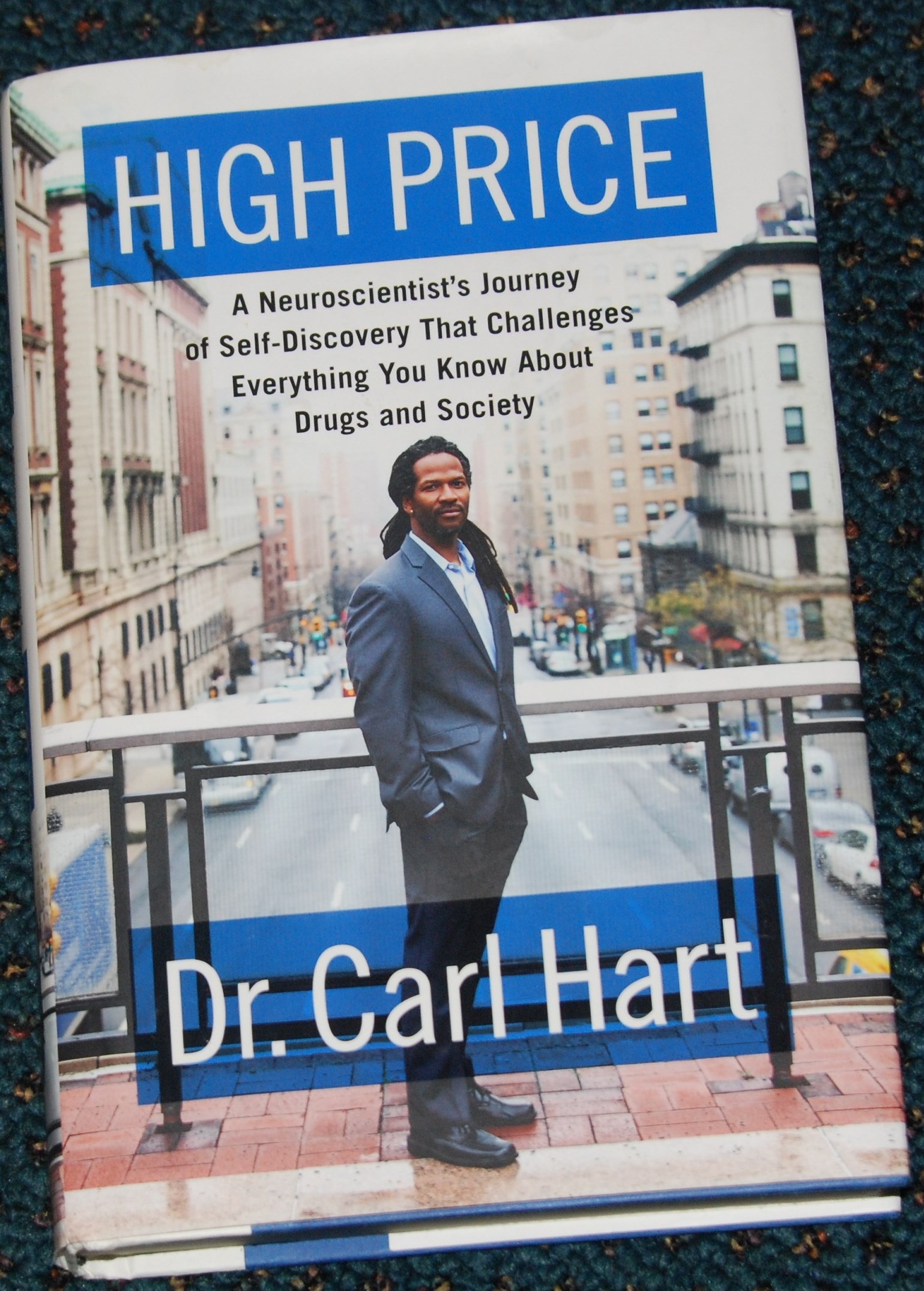
Book cover iamge is the elephant in the room.

Book cover iamge is the elephant in the room.

It is very easy, in the contemporary atmosphere of political correctness of advocating a color blind society, to overlook the biggest elephant in the room that is right on the front cover of the book. Dr. Carl Hart is not just obviously black or African-American but he is wearing a suit and dreg locks. How many African-Americans who wear dreg locks are neuroscientists? Will the fact of his looks lead the potential readers to dismiss his book and therefore profound ideas? Will the readers wrongly judge the book by its cover? “As my scientific career moved forward, the number of black peers around me dwindled until frequently I was the only black person in the room. When I got my Ph. D. in 1996, in fact, I was the only black man in America to receive a doctorate in neuroscience that year.” (Hart, 2013: p. 221) If my entire argument was about his looks and his low social racial status in our present society, I would not waste my time writing this raving review.

Dr. Carl Hart discusses and exposes the massive misleading hysteria in American society since the early 1900s that wrongly portrayed African Americans as smoking marijuana and becoming high and crazed. While in this drug-induced craze, they would go on violent rampage endangering peaceful white communities especially white women. Except all of these assumptions were never true although they led to American society making marijuana illegal and inflicting stiff punishments on those who broke the law according to Dr. Hart. The actual impact of the marijuana as a drug was never really addressed or scientifically investigated rationally.

Crack Cocaine Hysteria

Dr. Hart fast forwards to the white powder and crack cocaine hysteria of the 1980s. The media, law makers, and society portrayed the black inner city crack cocaine user as an irrational addict, violent, crazy, and desperate to do anything to get a fix. The consequences were broken black families, high unemployment, rise in violent crimes, and dislocation of the inner city black neighborhoods. Harsh laws were passed against cocaine use that had the unintended consequences of incarceration for longer terms of large black male population while whites who perhaps used even more cocaine were hardly imprisoned. Dr. Hart debunks these myths and argues using his own research in neuroscience and his own abuse of drugs earlier in his youth that, most, if not all the assumptions we make about drugs, addictions, and their impact on African –American neighborhoods in the inner city may be wrong and based on hysteria. He says this might be the case even among the highly acclaimed research by prestigious neuroscience researchers who publish their articles in exclusive highly peer reviewed journal publications. This reviewer asks what good is a highly peer reviewed published research article if the entire foundation and assumptions that undergird the research might he seriously flawed?

“It became increasingly clear to me how prejudices about drug use and our punitive policies toward users themselves made people who take drugs seem less human and less rational. Drug users’ behavior was always first ascribed to drugs rather than considered in light of other, equally prominent factors in the social world, like drug laws.” (Hart, 2013: p. 260)

Challenging the Existing Paradigms

One of the most profound claims that Dr. Hart makes which will resonate and likely suddenly make so much logical sense to the reader is that any drugs that are introduced among any people, and especially African-American inner city neighborhoods, are done in the context of preexisting social pathology: unemployment, crime, poverty, violence, dislocated families, social isolation, poor schools and education, despair, and hopelessness. People in these circumstances may use drugs not because the drugs themselves cause the social pathology but it may be the other way round. People will use illicit drugs not because of the intrinsic and compelling neurological impact of drugs on the brain, but because individuals who live in and are experiencing debilitating social pathology may find drugs attractive to alleviate their anxiety, hopelessness, social isolation, and alienation. If this assertion by Dr. Hart does not challenge and question our entire epistemology and paradigm about drugs and society, I don’t know what will. The  entire book provide compelling evidence in support of his assertions.

Inspirational

“High price” will perhaps be inspirational to many readers. But it raises many questions as it also confirms many uncomfortable realities of American if not Western society. I find it frustrating that 50 years after the Civil Right Act, Dr. Carl Hart and perhaps millions of African Americans still live troubled lives of poor education, poverty, and rampant racial discrimination and segregation. Large segments of this population may not still be part of the American mainstream and may feel alienated.

I find the book to be so highly interdisciplinary that I recommend it for all scholars and especially teachers of social and natural sciences. If you just read or see the cover this book and dismiss it as “it deals with African-American and minority marginal issues”, you will be making a grave academic mistake. The beauty and strength of this book is that you can extrapolate and apply the ideas to many scientific, social ideas, perspectives and problems. After reading the book you just become a more educated and better informed person.


Inside the Presidency: Book Review

By

Mwizenge S. Tembo, Ph. D

Professor of Sociology

Dickson Jere, Inside the Presidency: Trials and Tribulations of a Zambian Spin-Doctor, Oakville, Ontario, Canada: Nsemia Inc. Publishers (www.nsemia.com) 2014, pp. 237, $27.00. K185.00, Paper.

I was browsing for Zambian news on the internet when I came across a horrendous story. Some reporter had taken very graphic images of a woman giving birth in the middle of the street in Lusaka. The graphic photos were apparently being circulated on the internet and the local papers to show how incompetent President Rupiah Banda was in handling the nation-wide strike by medical doctors. I was very furious asking myself: “how would any Zambian or let alone a reporter think such a graphic photo that grossly crossed basic lines of ethics and decency was the best way to show that a political leader was incompetent?”

“A reporter for the daily Post newspaper obtained harrowing images of a woman giving birth without medical assistance. Those pictures were circulated. Somehow the images found themselves on my desk and that of the President. One of his private secretaries must have put the envelope containing the photos in the president’s office without alerting him of the contents. He was extremely angry when he saw them. “This is very unethical and unAfrican,” he said as he threw the pictures away.” (Jere, 2014:p. 63)


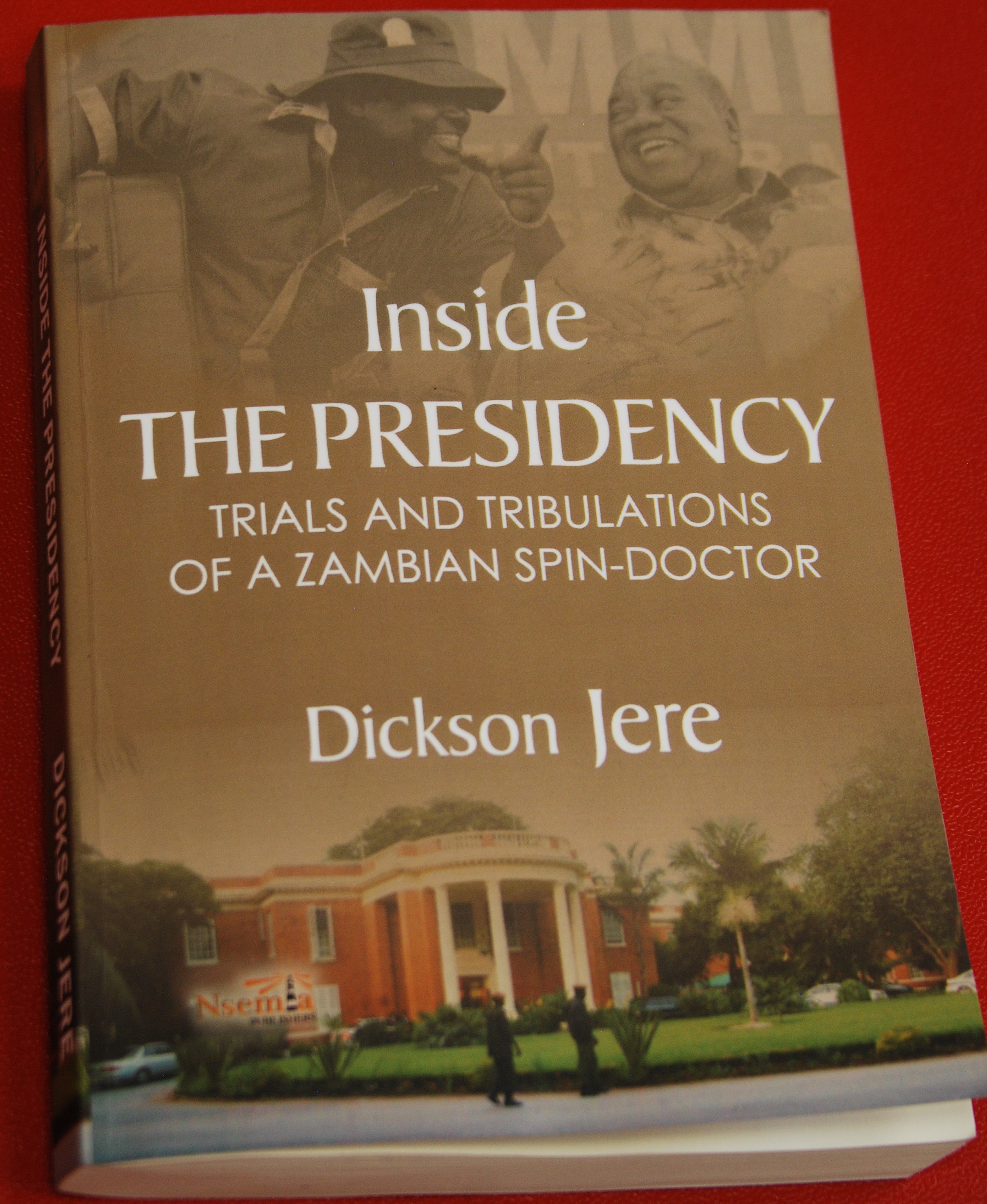
Cover of the book: "Inside the Presidency."

Cover of the book: “Inside the Presidency.”

This is among the many inside stories  of the  challenges and triumphs that the former President Rupiah Banda faced during his presidency from 2008 after the death of President Mwanawasa to 2011 when President Banda lost in a general election to President Sata.

There are many Zambians since 1964 who have worked very closely with former Presidents Kenneth Kaunda, Chiluba, Mwanawasa and Rupiah Banda. Although some of the people may have written some articles, given some interviews and perhaps a book, none have written an inside story. They have not answered the biggest question that most of us Zambians may be curious and ask: “How does it feel like to be the closest person to the President?”

Inside the Presidency: Trials and tribulations of a Zambian Spin-Doctor by Dickson Jere breaks new ground as he is the first Zambian in contemporary times to describe his experiences a President’s closest aid, confidant, advisor, and Spokesman. I found the 23 chapters in the book to be a fast paced quick read. I read it over 2 evenings after dinner in between my heavy teaching work schedule. If you are among the 13 million Zambians who are in the country and especially if you are in the diaspora, this is the book to read to understand one of our former Presidents.

Many readers will come to their own conclusions once they also read the book. I learnt four main things about my country from reading Dickson Jere’s story. First it seems any member of the press can print or publish any serious allegations of corruption or scandals about a sitting President with no judicial, criminal, or court consequences even when the story later proves to have no credible proof.  It seems there is little press accountability for reporting possible falsehoods. Meanwhile, the President or any political leader’s reputation will have been destroyed with virtually no recourse. Second, just as I have always thought, being a President is the toughest job in any country including Zambia. Dickson Jere was very lucky to go on this very thrilling ride to do something that served the public interest of Zambia as a nation.

Third, I was very proud of and became teary eyed about my country of Zambia when President Rupiah Banda peacefully conceded defeat after the elections and handed over power to the new President elect- Michael Sata. President Kaunda had done the same thing in 1991 after UNIP had lost elections to MMD by a land slide.

However, I was very scared when there was political revenge violence soon after the elections. I was tense when Dickson Jere’s house and family was threatened by mobs of youths banging at his gate at 4 hours as they perceived him as the enemy. “But the systematic attacks on MMD supporters increased. They were beaten and their homes looted that whole week following the conclusion of elections”. (Jere, 2014, p. 211) Although the violence could have been worse, violence is something that all Zambians, political leaders and parties should discourage before and after elections.

Fourth, what appears to be unjustified harassment or tormenting of former Presidents by the new government that has just been voted into power has to stop. “The new government carried out sustained negative campaign against the former President since he left office. He was depicted as corrupt man who was involved in several questionable deals with members of his family. The government also threatened to withhold his benefits unless he quit his position as MMD president because the law prohibited former presidents from engaging in active politics.” (Jere, 2013: p.224) Former Presidents ought to retire from politics to travel and conduct national and international diplomacy and peace building.


Dennis Liwewe: Zambia Vs. British Colonials

by

Mwizenge S. Tembo, Ph. D.

Author of “Satisfying Zambian Hunger for Culture”.

Professor of Sociology

Dennis Liwewe’s  greatest radio commentary in his illustrious career was perhaps the football game that took place at Woodlands Stadium on October 23, 1964. This was twelve hours before Zambia’s independence from British colonialism on October 24, 1964. The old scratchy sounding audio tape of that greatest game was forgotten in the dark back shelves of the then Northern Rhodesia Broadcasting Services, later ZNBC and Zambia Information Services. A patriotic Zambian whisked overnight by air to me the old audio tape for computer digital reconfiguring by the crack team of the University’s Information Technology Center. Since parts of the audio tape have deteriorated over the last 49 years, some parts of the football game are missing with lots of crackling shhhhh transistor sounds.

Dennis Liwewe: Shhhhh…..”Good afternoon to my fellow  2 million Northern Rhodesians who in exactly 12 hours are to break away the shackles of colonialism and oppression to become citizens of the free great and independent nation of Zambia and a new member of the United Nations. I am broadcasting from Woodlands stadium on a bright sunny hot October afternoon. The Zambian side has fielded a team that has the least experience in playing football  as for many years the players were involved in the struggle for freedom. The British Colonial team is fielding their best many of whom are seasoned veterans who have played in top English Football clubs. The Zambians have tremendous heart and determination against the British Colonials team which has all the experience. Starting lineup for the Zambian side is number one Goal Keeper  Grey Zulu, number two the sweeper who is the back bone of the Zambian defense is Munukayumbwa Sipalo…….Shhhh!!!!! [tape breaks away]

Dennis Liwewe: Shhh!!!! “…..Peter Matoka passes the ball to Arthur Wina, Arthur Wina the brother to Sikota Wina passes it to Dingiswayo Banda or “Dingi” the half back. He is challenged and loses the ball to Godwin Hunter of the British Colonials. Hunter passes the ball to Sir Edgar Willimson the midfielder  of the British who quickly picks up momentum. The British are on the attack!! John Mwanakatwe challenges but is beaten, the ball is crossed to Alexender Chambarlain the British left forward who chases the ball to Zambia’s left corner flag. John Mwanakatwe, Dingiswayo Banda and Reuben Kamanga all challenge the intruder. This is a dangerous situation for Zambia’s inexperienced team. Alexander Chambarlain like a magician dribbles the ball and breaks through the cordon of the three Zambian  defenders. Chambarlain has only Munukayumbwa Sipalo to beat!!!! Sipalo slide tackles Chamberlain… the ball bounces out of bounds for Britain’s seventh corner!!!  Ya! Ya! Ya!!!! Britain’s seventh corner!  [Loud uhhhhh!!! From the crowd]. Shhhhh!!!! [Tape Breaks up]

Dennis Liwewe: Shhhhh!!! “……Five minutes before the end of the first half and the score is still zero zero. Chambarlain will take the corner kick from the left side of Zambia’s goal. Goal keeper Grey Zulu has to be alert. Zambia has packed everybody in the penalty box. The corner kick sails above the front of the goal. Sir Roy Welensky heads the ball into Zambia’s penalty area in a dangerous situation!! Commotion in front of  Zambia’s goal area!!!! Away!!! Sipalo clears it away in a dangerous situation!!! ….. The referee has blown his whistle… it is half time. The score is zero zero. Zambia has to regroup if we are to win this game. The front line of Simon Kapwepwe, Kenneth Kaunda, and Mainza Chona have to produce goals. The midfield and Munukayumbwa Sipalo and the defenders have worked so hard to keep the bombarding British at bay for 45 minutes……..”[Break in the tape]

Dennis Liwewe: Shhh!!!!!!    “…….both teams are tired.. it is 40 minutes into the second half and the score is still zero zero. It has been a hard fought game.  Here come the British Colonials again launching an attack. Full back Phillip Limestone passes the ball to Chester Clifford, Clifford to Brandon Bentonbarbour, Bentonbarbour to Sir Edgar Williamson as the Zambians are packing in the defenses. Peter Matoka, Reuben Kamanga Simon Kalulu, Simon Kapwepwe and Kenneth Kaunda are all in the back field to repel the British attack. The dangerous left forward Alexander Chamberlain has the ball as he is challenged by John Mwanakatwe. It rolls out for a throw in to British Colonials. The long throw in lands in Zambia’s danger zone as the British are bombarding us with guns, tanks and the air force and we Zambians have only bows and arrows. Striker Sir Row Welensky kicks the ball over the cross bar for a goal kick to Zambia.  Goal Keeper Grey Zulu quickly takes the long goal kick. The British defenders had moved to near center field!!!!  It is a now a race between Kapwepwe and Kaunda and the experienced British full backs Braxton and Phillip Limestone!!!!!……Kapwepwe is going!!! he is  running with the ball on the left flank towards the British goal and Kenneth Kaunda is running on the right flank towards the British goal!! The British defenders are left behind… Simmon Kapwepwe has only the goalie Bradley Carpenter to beat, Kapwepwe passes the ball to Kaunda …..it’s a g-o-a-l!!!!!!!!!!! Kenneth Kaunda it’s a goal!!!!!!!!!!!!!!  One zero Zambia is leading the British Colonials!!! Kaunda is running around leaping in the air pumping his fist as Kapwepwe embraces him. The team has mobbed Kaunda in a big pile of celebration. Zambia’s reserves on the bench have cleared and run on to the field  to join the team in a wild celebration; Lewis Changufu, Aaron Milner, Sikota Wina, Nalumino Mundia, Justin Chimba, Elija Mudenda including the only white member of the Zambian team James Skinner. Even the youngest player who is only 18 years old Vernom Mwaanga had joined the team on the field!!!![loud deafening noise from the crowd][Break in the tape]

Dennis Liwewe: Shhhhh!!!!! “…..the referee has finally cleared the field…..two minutes to go in injury time of the greatest game ever for Zambia. Zambia leads one zero over the British Colonials. The Zambians  have packed everybody in defense. The referee is looking at his watch. He has blown his whistle. Zambia wins the game One Zero!!!!!! There will be celebrations to day from Kalabo to Mpulungu, from Livingstone to Kafulafuta to Mwinilunga to Chipata…… [tape break] shhh!!!!!!!

Post Script: I had tears in my eyes as I listened to this tape of the great Dennis Liwewe. If ever a country is given a gift from God it is Dennis Liwewe as a gift to all Zambians. As a Zambian who spent many years listening to Dennis Liwewe on those Sunday afternoons, my hope is that when I die, I will go to heaven. There will a football game there between God’s Angels Eleven versus the Chipolopolo Boys or the KK eleven. I will not want to watch the game on TV if there is one in heaven but will instead  listen to the radio commentary of the game by the Great Dennis Liwewe. That will be second heaven to me while I am already in heaven. May Dennis Liwewe’s Soul Rest in Peace.

The “Dirtiest” Book Ever? :Satisfying Zambian Hunger for Culture

By

Mwizenge S. Tembo,  Ph. D.

Professor of Sociology

“Greetings Prof Tembo, 

It is with the great joy writing to you to express my heartfelt joy using your book titled: Satisfying Zambian Hunger for Culture: Social Change in the Global  World. Bloomington, IN: XLIBRIS, 2012. I would like to say thank you very much. I am still writing a book review on it. I had almost finished then my computer had viruses so I lost some data on it.

Baba aTembo, lomba mweo baba, how do you use the concepts of “Uncle, Aunt and Cousin?” Are you using the named terms with the urban context or rural or both? I am using your book now, and I am somehow disagreeing with the usage of these concepts. Kindly indicate the context? (Cf. 46 of your work). In my paper I write, as suggested by Mwizenge S. Tembo, in the Senga-Luzi culture, a child “has more than one mother, father, brother, sister, uncle, aunt, grandmother, grandfather, and of course cousins and in-laws.” I strongly disagree with Mwizenge S. Tembo on the concepts of  uncle and cousins unless these concepts are used cautiously and among the selected few urban families. Even in urban setups, when one is called uncle, aunt and cousin, their relationship is quite distant. 

Once more, thanks for this great masterpiece. It’s one of the dirtiest books I have ever read while in the Zambian diaspora. 

Regards

Tembo Tembo Michael” (Not related to the author)

I was thrilled to read your e-mail as the author of the book. But your use of the word “dirtiest” in your last sentence first surprised me and then it made me smile. I tried to guess what word you had meant to type. When I failed to guess, I sent you another e-mail to ask you to explain. Then I received your e-mail in response.

“Oh no, sorry, I wanted to write, it’s the book I have dirtened with a highlighter. I have labelled so many pages in the book! I have really written in it very much and really enjoying it. I will do likewise when I am done with the book review.

This is my key textbook done by a Zambian scholar! It’s respectable work at my school. I have used it in my research works. Some Profs have been asking me if we are related. I answer them, the surname says it all. 

I am in Texas, at Oblate School of Theology. 

Once more, thanks for the great work and keep it up.”

I want to thank you very much for your kind words. I am very glad that you enjoy the book tremendously and you are finding it helpful in your academic papers at your School of Theology. Before I continue to respond to your questions, I am conscious that readers might assume that this is a publicity stunt for the book. I have not met you before and we are not related although we share the same last name which means our origins may be from the Eastern Province.

What you do when you read a book you very much like is exactly what I also do; mark them. All my books that I read and like I mark very heavily writing questions, both positive and critical comments on the edges of the page. So when you said you “dirtened” the book, that’s the sign that you are both enjoying and critically absorbing the ideas from the book.

The kinship relationships and terminology that I describe on page 46 of the book are common among my tribe; the Tumbuka and also the Ngoni in Eastern Province and may be going all the way to the Zulus in South Africa. I am sure similar kinship systems and terminologies exist among probably dozens of the 72 tribes of Zambia. Anthropologists have classified this as the Omaha kinship system which is among more than four  major types found in societies all over the world. The only question is whether many tribes or ethnic groups follow this system in Zambian traditions. For example, among the Chewa of the Eastern province of Zambia and also of Malawi and Mozambique, the most important kinship has been that between a woman and her brother whom they call malume or uncle.

Most families in urban Zambia today might be so removed from knowledge of their ethnic or tribal kinship systems that the use of “uncle” is used to refer to close relatives but also friends of the family who are the father’s age. “Aunt” is used to refer to close relatives but also friends of the family that are the mother’s age. May be this is what you disagree with. I am sure that there are still some families in Zambia and abroad that still follow their traditional kinship relationships and terminology.  I whole heartedly welcome the disagreements because that is part of intellectual discourse.

The book Satisfying Zambian Hunger for Culture can be used for so many different purposes; families can learn about Zambian culture, middle school, high school or secondary and college students can use it. Professors can use it as I do for teaching anthropology and Sociology. I recently gave a guest lecture in Professor Deborah Dunn’s class on “Nshima and Zambian foods” to her course on “International Foods and Nutrition” at our college. The book is so rich with our cultural history but also provides  some vision and recommendations for the future. There is no comprehensive book that does this well right now. I am glad you are finding the book very useful.


As a last comment, this discussion reminds me of when I was a student at University of Zambia in the early 1970s. A Zambian student told his European lecturer or Professor that he was going to be absent from his class because he was going to a funeral because his mother had died. Six months later the same student told the same Professor that he would miss class again because he would be away to attend to a funeral of his mother who had just died. The European Professor thought the student was being less than honest until the Zambian student explained that in the Zambian and African traditional culture, he had more than one mother. I am proud that I have had three mothers; my mother’s only younger sister who passed away in 1984. I have two living mothers; my mother who lives at Chainda Farms in Lusaka. Today we would call her aunt. Then I have my biological mother who is still living in the village. I call both women amama. They both know it and they are happy.


The Bare-Breast Controversy: Kulanga and Proper Conduct at Public Ceremonies.

by

Mwizenge S. Tembo, Ph. D.

Professor of Sociology

When I was young growing up in the village, one day I rushed home to my parents to report that my brother had insulted and used the worst vile language, kutuka, in Tumbuka against another boy in a quarrel. I repeated the vile disgusting graphic language to my parents word for word to make sure I was reporting accurately. To my utter shock, my parents proceeded to angrily berate me for the report. When my brother who was the  guilty party arrived, my parents gave him lighter punishment and milder tongue lashing. What was my mistake? Didn’t I report accurately what had happened? My parents’ response, which was in form of Kulanga, https://www.youtube.com/watch?v=NHz_bMRl2Rc   was that my reporting and repeating the actual graphic language was a further degrading and a humiliating insult to them and those listening; it was like adding salt to a wound. Better I should have just said my brother had insulted someone very badly without repeating the vulgar language.

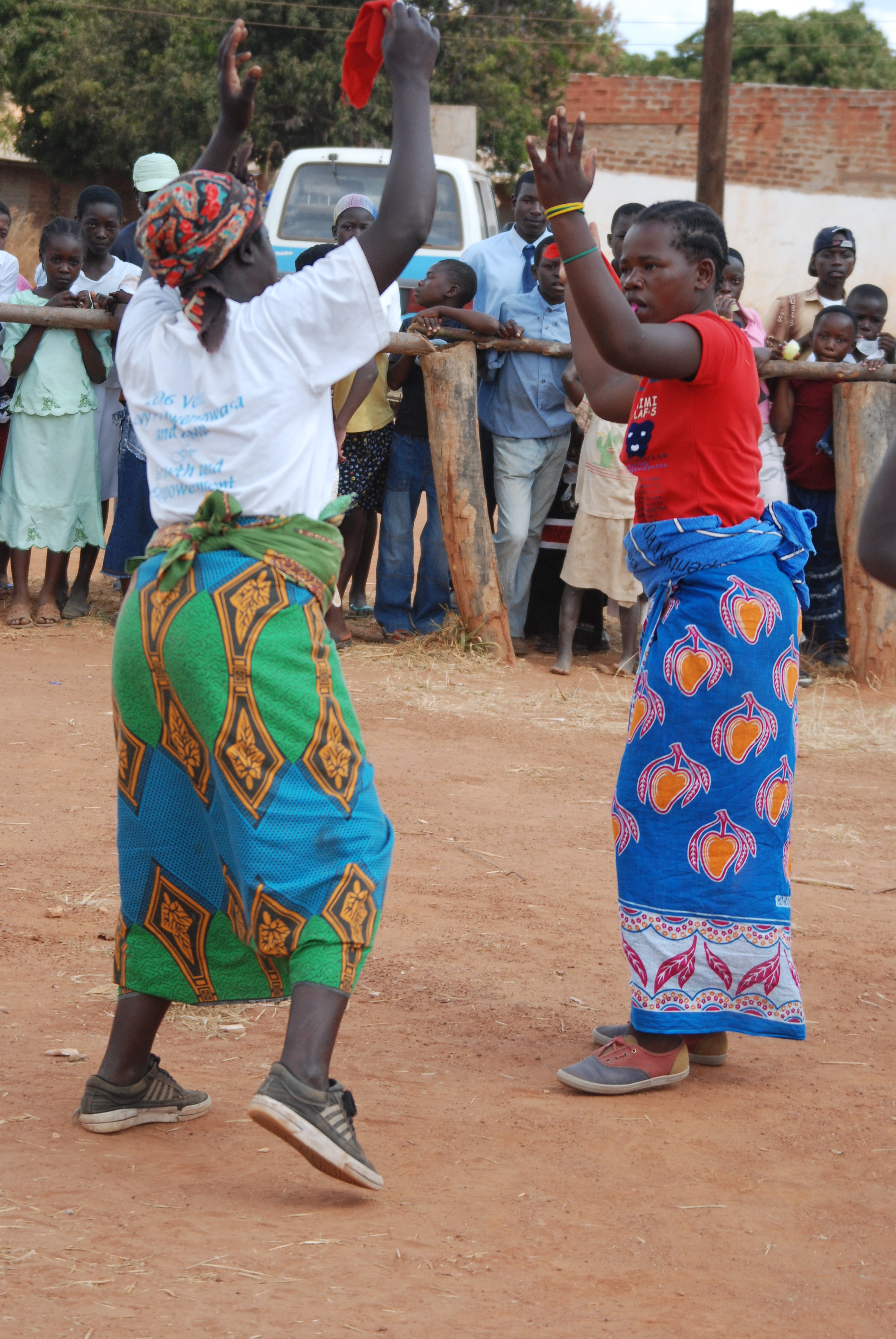
Women performing the Kioda dance at the annual Agricultural Show in Lundazi in July 2007.

Women performing the Kioda dance at the annual Agricultural Show in Lundazi in July 2007.

A few years ago when Rupiah Banda was President, the medical doctors had a dispute with the government over low or poor pay. The doctors went on strike. This caused so much disruption in the normal operation and services of the hospitals that somehow a pregnant woman had to give birth in the middle of the street. A Zambian who had a digital camera took the graphic picture of the woman giving birth and went ahead and posted it on the internet media. The person argued that this was freedom of the press, transparency and showed how the government of President Rupiah Banda was mishandling the case of the striking doctors. If you think everything and anything should be posted on line because it promotes transparency, democracy, and shows freedom of the press, you should stop here and not read the rest. You might not like what will be said next as it follows the tradition of Kulanga. I will not describe the stories in graphic detail or show you where you can see the pictures according to the wisdom of my elders.

There have been two controversial media stories in the Zambian press recently. The first one was a young Zambian folk musician who apparently riled the Ngoni Royal Establishment (NRE) because the musician is shown in a photo pulling the nipple of a bare-breasted old Ngoni woman at the Ncwala ceremony. The musician is his defense said he was practicing “chimbuya” with the old woman. Another story was yet a second photo from the same ceremony where another young man is holding the bare-breast of a woman. One thing should be made clear. This author is not against both young and older women being bare-breasted at these ceremonies. The beauty of the human body and its expression should be celebrated according to the appropriate rules of conduct in our culture. This is something that I totally support and am very passionate about. But there is nowhere in traditional Zambian history and the present where the culture says any man has the right to openly grab any woman’s bare-breast during these ceremonies. Our culture never encouraged degrading sexual exhibitionism in public.

Women dancing the Kioda at the annual Agricultural Show in Lundazi in the Eastern Province in July 2007.

Women dancing the Kioda at the annual Agricultural Show in Lundazi in the Eastern Province in July 2007.

What is probably more important is that all the Zambian media that published the humiliating photos should have the primary blame. If you are a credible Zambian media, the Editors should not have published the particular photos in question. Because they have zero redeeming value and only serve to humiliate and embarrass all of us Zambians to ourselves and because of the viral nature of internet technology, the whole world might have seen the photos.

The second person to blame are the photographers and especially if you are a private individual with a personal cell phone camera. You might even enjoy and be excited about taking selfies. All photographers should have a moral campus. Just because something is happening it does not mean you should photograph it or post it on the internet. I know what I am saying goes against the tsunami that is the digital generation because I will probably be thought as a prude, a  fontini, too conservative, tin pot dictator, or living in the old or dinosaur past. I have digital cameras and have been taking thousands of photos since 1967. It is not about taking away your freedom of expression but it is learning about making good judgment about public moral integrity and dignity. There is no freedom without dignity and responsibility anywhere in the world. If you believe this freedom without any controls, it is a myth. Think about the hurt and degrading feelings of the victims, especially of the old woman who appeared in the photo and public pain her family and relatives have felt. Those photos will never be taken back from the internet.

As a nation we may have a need to have a conversation about this matter in the light of the digital age technology and millions of younger Zambian audience who attend these ceremonies where people and especially girls and women may be celebrating bare-breasted enjoying and expressing our culture.  There might be slaughtering of animals and other graphic rituals that may be part of the ceremonies.

This is a message to all the Royal Establishments of the many wonderful Zambian traditional ceremonies: Chibwela Kumushi, Kulamba Kubwalo in the Central Province,  Kulamba, Ncwala, Vinkhakanimba in the Eastern Province,  Umutomboko in the  Luapula Province, Chibwela Kumushi in the Lusaka Province, Ukusefya Pa Ng’wena in the Northern Province,  Likumbi Lyamize  in the North Western Province,  Lwiindi, Shimunenga in the Southern Province, and Kathanga, Kuomboka in the Western Province. All the Royal Establishments should consult with their subjects, the public, Members of Parliament and the President to establish the rules of conduct to be followed by all ceremony goers and participants. If a ceremony goer happens to take a risky or embarrassing private photo, let it remain private. There should be an orientation and dissemination of lessons for all participants before they go to the ceremony so that they will know how to behave and conduct themselves.


The Significance of Kuopa or “to fear” and other Zambian Customs.

by

Mwizenge S. Tembo, Ph. D.

Professor of Sociology.

In September 2012 just a few weeks after my book “Satisfying Zambian Hunger for Culture”  was published, I was a guest on Mr. James Mwape’s Blog Radio to discuss some aspects of Zambian culture.  A Zambian man called and said he was married to a non-Zambian  woman and lived in New York City. They decided to go and visit his Zambian parents who lived in the City of  Mufulira on the Copper belt. The couple stayed at his parents’ house. The second day they were there, the non-Zambian wife decided to wear some very tight shorts and a tight top that may have revealed probably too much in the context of the in-laws’s household. The Zambian’s father and mother were embarrassed and uneasy. When the Zambian husband asked his wife to wear something a little different may be more modest may be with a chitenje, her reply was that it was too hot and she had the right to wear what she pleased. Of course all of this broke many Zambian traditional customs including obviously the crucial  “kuopa” custom that is practiced between in-laws.

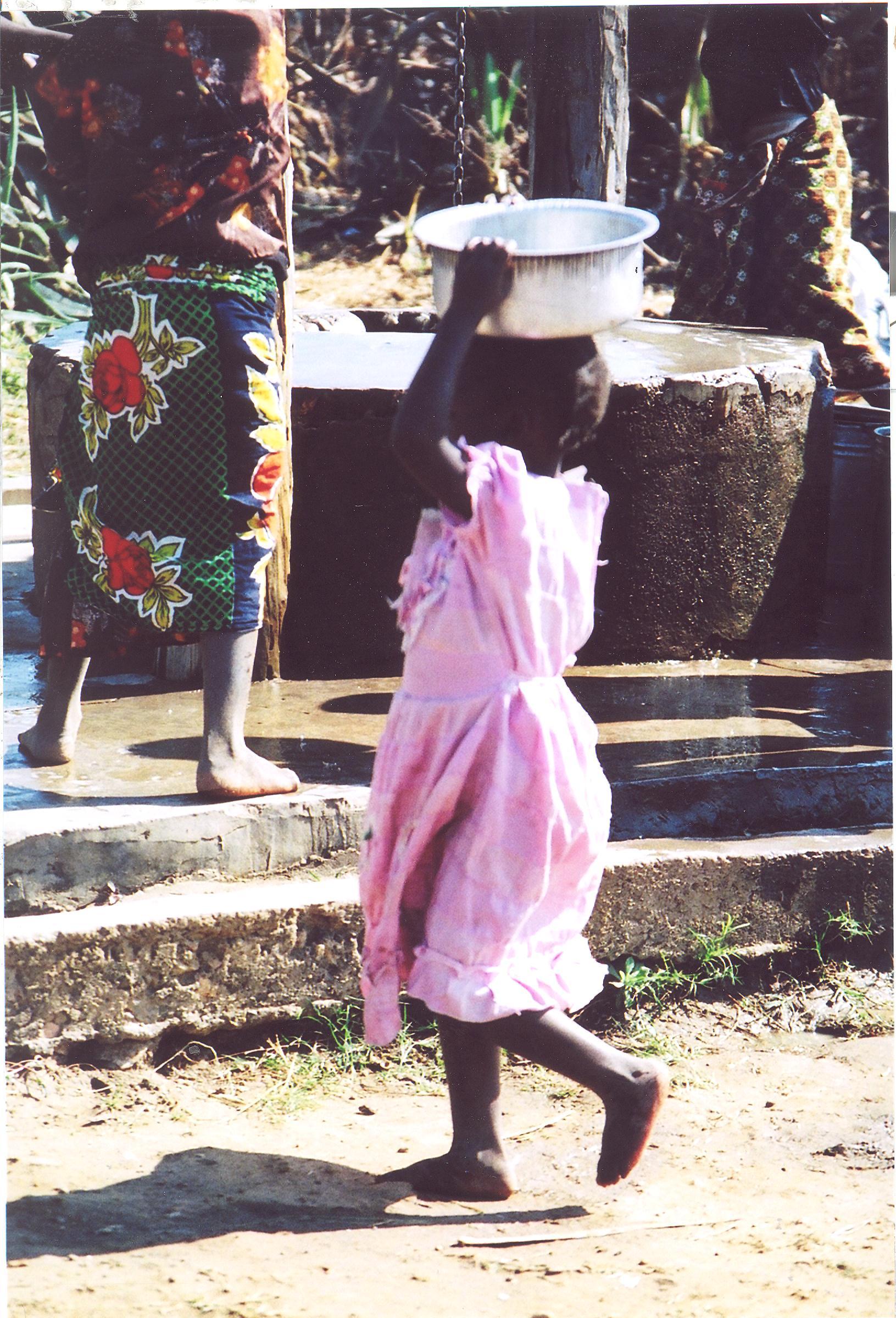
Girls learn chores and responsibility at a very young age.

Girls learn chores and responsibility at a very young age.

On the same program, a Zambian woman called  who was married to another non-Zambian. She complained that when she behaved like a daughter-in-law would towards her father in-law according to Zambian customs by say, staying out of the living room where her father-in-law was sitting, the husband’s family complained that the Zambian wife had an unfriendly “attitude” wondering why she was always subdued and walking out of the living room when her father-in-law was there.

Although these two stories might look like the author is singling out foreigners or non-Zambians, this can actually happen to any individuals and sometimes even among Zambians in Zambia and abroad depending on their social upbringing. There is a famous song by Nashil Pitchen “Apongozi Amasiku Ano” in which he laments that the younger husbands in the cities in Zambia are so disrespectful these days. https://www.youtube.com/watch?v=JnQwhvY4_3o

They walk into their mother-in-law’s house without knocking. Supposing the mother in-law is taking a nap, says Nashil Pitchen, on the living room couch and her covers accidentally fall off in her sleep and she is partially naked, that would be very disrespectful and embarrassing.

Everyone knows that we are experiencing tremendous social change as Zambians. But some of our customs need to be understood better so that we can know how to behave better within our families while following some of the very positive Zambian customs. These customs  traditionally exist in virtually all of the 72 tribes in Zambia including among the Lozi, Tumbuka, Ngoni, Chewa, Tonga, Kaonde, Luvale, Bemba, Lunda, Chokwe, and many others.

You are lucky if you are a Zambian and married to a non-Zambian who might be aware and has enough humility when you visit back in Zambia or even when abroad, that the family and kinship customs are important enough for the individual to try their best to practice them.

These video clips from my recent lecture at the Virginia Mennonite Retirement Center Lyceum Series in Virginia in the United States, explain three important Zambian customs: Kuopa or “to fear”,  https://www.youtube.com/watch?v=YNRPnmd7iVE

Kulanga or disciplining and giving guidance to children, https://www.youtube.com/watch?v=NHz_bMRl2Rc

and kusungana https://www.youtube.com/watch?v=mIzt5PwafJY

which expresses the deepest love between a married man and a woman. These are good customs that reflect being civilized. They are neither primitive nor backward. I make this argument in my lecture.  Please send the clips to anyone; your children, friends, even people in Zambia and people who need to know these customs. I am sure that ZNBC radio can probably use the video clips. Please forward the clips to them if you get a chance.


Role of Sex in Marriage: the Zambian Cultural Heritage

February 5, 2014

I was talking to a man in his sixties in the village in Lundazi in the Eastern Province of Zambia. He told me that some muzungu first came to the district about thirty years ago and asked the villagers to dig up these green stones. The white man told them the green stones were so worthless he would pay them about Ten Kwacha for a big 10 kg. bag. The man says he now knows the deep green large emerald gems were so precious that the first whites who knew the full value of the gems made a great profit. He regretted that for a long time that the Zambian people in the villages did not realize the real value of the emeralds.

I was reminded of this when I recently read this controversial story in the Post: “A two minute video depicting a half-naked woman explicitly demonstrating an assortment of love-making postures to a bride-to-be during a traditional all-female counselling session and posted on social networking sites has annoyed traditional counsellors. Zambia National Traditional Counsellors Association founder Iress Phiri yesterday described those who leaked the video as “stupid fools”. (The Post, Jan 31, 2014)

I did not need to see the video as the descriptions in the story were enough for me to understand what it contained. But I did not want to be accused of criticizing the video when I did not see it or similar to committing the act of criticizing a book when I have not read it. When I went to check the video on line, it had been already taken down. I don’t know whether the people who posted it felt some shame or were afraid of being sued. I also know that YouTube and other respectable on line cites are not interested in posting vulgar images or pornography or images that may be offensive to communities.

What every Zambian reader young and old should know is that teaching “love-making postures to a bride-to-be” is a very precious custom that all proud Zambians should cherish and protect. The report about the posted video says that some people could be heard giggling in the background in the video  and making fun of the training demonstrations amidst some drumming.

Sex in marriage is such a special, important, private, and sacred act that both brides and grooms should be properly trained before they get married. This is why the traditional Zambian customs had elaborate customs and training rituals before a young man and woman got married.  When entering marriage, the bride knew and had been shown and taught by older experienced married women what would make her husband happy and the groom had been shown by older experienced married men what would make his wife happy. This knowledge should be private and only those who are to be married should have the access, privilege of participating and gaining the knowledge.

There are those who will argue the loudest for transparency, openness, democratic rights, and that the video images and the inside information should be made public so that everyone should know and learn. The answer is No. This same point is emphasized in the book Satisfying Zambian Hunger for Culture: “Many traditional cultural practices were very special, sacred, and only secretly exposed to special groups or age sets or cohorts who were going through the rite of passage……These are sacred ceremonies which are very meaningful to adults and their young people who are anticipating and can’t wait to participate in them. Parents, families of young people, and the entire close knit community are anxious and interested in passing on very important life values to the young people…..We hope most of these practices will be kept confidential.” (Tembo, 2012; p. 38)

Because many Zambians, especially those who are educated, may regard these rituals as archaic and primitive because of the Western colonial Eurocentric influence, they may regard these rituals with a certain disdain, embarrassment, unease,  and unwillingness to embrace the customs. Prof. Kenneth Mwenda makes this point when he asks: “But why are African people, generally, so afraid of recording their culture and traditions? It baffles me. In the end and notwithstanding that culture is dynamic and that it changes, we will end up with a lot of misrepresentations and distorted interpretations of these same normative processes because they have not been systematically recorded and archived.”

Besides this failure to embrace our cultural traditions, there are very few Zambians who are aware that many of these traditions might go back to the traditions of not only the Lozi, Bemba, Tonga, Chewa, Ngoni, Lunda, Kaonde, and Luvale and many other peoples of Zambia, but these customs go back to over three thousand years ago when we Zambians and Africans created these customs as origins of the entire humanity. These customs may have been happening before the Greek Civilization, the Roman Empire, the time of  Christ, and the Prophet Mohammed. But of course, like that man in the village in Lundazi who did not know the value of the emeralds, we Zambians do not know the full value of, meaning, and functions of these precious customs and rituals and especially their history. Most of us just think some tribal backward, uneducated or fontini people in the villages just made them up for no good reason or for  lack of better entertainment. Then we might wonder why many non-Zambians especially in the Western society, many Whites and other non-Zambians admire them and there is a growing demand to want to participate in rituals and customs that prepare both young brides and grooms for marriage.

Ms. Claire Miti in UK makes the same point: “ 26,000 years of non-stop recorded African history! How about that? We are the only ones who don’t know that fact. …And of course Egypt itself. The biggest problem with us Africans, I find, is that we keep “disconnecting” ourselves from this history, from this knowledge…. Because we believe what we have been taught in our educational institutions that “Africans never made any contributions to civilization.”

Conclusion

If you want to know the complete descriptions of some of these Zambian customs and rituals you can read the book: “Satisfying Zambian Hunger for Hunger for Culture (2012) by Tembo. Another book is Traditional Marriages in Zambia by Chondoka (1988). When you fully understand the significance or important history of these customs, you will be reluctant to record the private sexual marriage rituals and thinking it would be really funny, titillating, and exciting to post the video on the internet, on YouTube,  or on Face book. I commend and encourage Zambia National Traditional Counsellors Association founder Iress Phiri and the members to continue their good work.

Should Zambian Languages be Taught in Schools?

January 16, 2014

Who among 13 million Zambians today will land the best job in Lusaka, Kitwe, Johannesburg in South Africa, in London in UK, Tokyo in Japan, or the United Nation in New York because they are fluent in Bemba, Nyanja, Tonga, or Lozi and dozens of other Zambian languages? The answer is no one. In introducing compulsory learning of Zambians languages in schools, is  the Ministry of Education wasting time and money? Will this policy encourage and create a resurgence of separatism, disunity,  and tribalism which the founders of Zambia tried hard to eliminate?  After all, a Zambian will communicate with more people in Zambia and the global world if they concentrate on knowing to read and speak English well as the Zambian official language. These arguments have been very common since independence in 1964. This article discusses some of the advantages of learning Zambian languages that many Zambians may not have been previously aware of. Some of the major reasons and advantages of  being bilingual and multilingual are very important in today’s world in spite globalization.

Because of all the knowledge, appreciating history, personal experiences from the village in Zambia to the United States, research, reading so much information and teaching some of it for the last 30 years, I have concluded that we Zambians, from the Ministry of Education Grade One  to grade 12 to all Universities in Zambia, we are teaching the wrong or distorted history to ourselves about ourselves. Our history as Zambians started  a long time ago from two hundred thousand years ago when we were the first humans in East Africa and Ethiopia. We spread all over the world. The evidence of us having been all over the world is all over the world right now. We just need to have the courage and conviction to find it and interpret it to the world. Europeans used to and have successfully blocked this knowledge but the internet will open the flood gate.

After early humans lived and migrated in small bands and communities for thousands of years, We Zambians and Africans created the Egyptian civilization. The arguments as to whether Egypt had white or black people may be irrelevant and it is a deliberate distraction, mifulungenye (Bemba),  msokonezo(Nyanja) kutangwaniska and kujalizgha (Tumbuka), or obfuscation that Europeans cherish which they introduced to justify the beginning of the Atlantic Slave Trade and later European colonialism in Africa. Europeans love to inject race into everything with whites always being superior somehow. African Egyptians in the north were olive skinned and those further south towards the equator were darker skinned.

The Egyptian civilization occurred for 2,010 or more than two thousand years from 3100 B.C.E to 1090 B.C.E. This was about 760 years before the ancient Greeks. The great Ancient Egyptian Civilization which African established was 2,460 years before the very young European Industrial Revolution of the 1700s and 1800s. The 1090 B.C.E to 2013 is 3, 013 years ago. Dr. Chisanga Siame’s article opened my eyes to the fact that using linguistic analysis known as  philology, etymology, and then the morphology, phonology, semantics and syntax of language you can trace “Siame” Namwanga Zambian name to the Pharaohs of ancient Egypt three thousand years ago. Zambian languages are very important as we Africans have used the Niger-Congo Bantu languages going back thousands of years. http://ukzambians.co.uk/home/2013/06/01/zambians-created-ancient-egypt/

Introducing Zambian languages will help us understand our real wider history in the origin of human civilization as our 72 tribes are part of the earlier African civilization going back thousands of years. The deeper meanings in traditional Zambian languages  in  Bemba, Nyanja, ChiChewa, Tonga, and Lozi have buried within them our true history going back perhaps to two hundred thousand years ago.

The learning, knowledge of and deeper proficiency in Zambian languages among Zambians also improves and widens our knowledge or world view which is known as cognition in psychology. For example, among the Nyanja or ChiChewa speaking people in the Eastern Province they have more than a dozen words to describe maize, mealie-meal and nshima-related terms. Because the Lozi in the Zambezi flood plain are a fishing culture, they probably have dozens of words related to fishing and fish related food. The Tonga people have a cattle raising culture. They probably have dozens of terms that are cattle-related. English may have no equivalent terms from these Zambian languages which limits cognition. Zambian languages are not just simple words for which we should create English equivalents, but reflect a much deeper epistemology and world view which may provide an advantage in the contemporary global world. For example I argue the nshima diet among 13 million Zambians may help to reduce obesity and gaining weight which is fast becoming a health epidemic. I discuss this in this article. http://www.infobarrel.com/Nshima_Diet_Maintains_Slim_Bodies

Because Zambian languages are what we speak as babies and children in families, this is why they are called mother tongues. They play a special role in our lives as they reinforce and express a certain emotional intimacy among Zambian families. My speaking Tumbuka expresses my deep connection to my mother, father, siblings, and kinship. These languages reinforce very important bonds when we are children and as adults.

Finally, speaking and understanding Zambian languages creates and reinforces national unity and patriotism. There is nothing as heartwarming when as a Zambian you are away from home for many years may be living in Tokyo, London, New York or Russia. When you meet a Zambian you experience a special joy whether they speak Bemba, Nyanja, Tonga, Lozi, Lunda or Kaonde. Although we would communicate in English if we don’t know each other’s’ traditional languages, we often use the much more intimate town lingua franca such as town Nyanja or Bemba, Lozi, or Tonga to express our national unity and patriotism. These are some of the factors why implementing compulsory teaching of Zambian languages in schools is the best decision the Ministry of Education has made.

Zambia Center for Contemplation of Knowledge

Before gaining independence from British colonialism in 1964, an estimated 3 million Zambians belonging to 72 tribes had traditional forums in their villages in which they discussed, contemplated and exchanged knowledge about all subjects. The men contemplated knowledge at the mphala among the Easterners and Insaka among the Bemba. The women contemplated knowledge and ideas at the mtondo or pestle and mortar among the women among the Easterners. I am sure the Lozi, Tonga, Kaonde, Lunda, and the 72 tribe tribes had different indigenous traditional names for such places of intellectual contemplation.

I am proposing that we create the first “Zambia Center for Contemplation of Knowledge”. This is a physical location where Zambian men and women from all parts of the country from the 72 tribes, all races, and the globe can retreat for the sole purpose of contemplating knowledge in a safe and secluded environment for a specified period of time. The selected intellectually seasoned men and women who will be privileged to report at the  Center will have been very carefully recommended and selected for their life long devotion to both indigenous and external knowledge. Before most readers make their own assumptions of the purpose of this proposed “Center for Contemplation of Knowledge”, perhaps the best way to describe it is to explain what this Center will Not be.

The Center will NOT be a place where young men and women can stay to write Masters’ thesis and Ph. D. dissertations to gain their degrees and be a stepping stone to improve their CVs for future careers. We have 13 universities in Zambia and thousands of colleges and universities abroad where individuals who are seeking this type of training can go. This is not the place where those who want to conduct technocratic or R and D research will go because we already have universities, institutes, government institutions, and other national and international organizations where such research is being and can be conducted. This will not be a place for holding workshops because there are already thousands of hotels, lodges, and other entertainment complexes in Zambia and abroad where seminars, workshops, main stream professional conferences are and can be held. The attendees at this Center will not be sponsored by international donor agencies and NGOs as our country is saturated by donor influences the majority of whom do an excellent job in providing solutions to some of the major problems we face as a society such fighting HIV-AIDS, hunger and poverty, provision of clean water, and empowering women and girls. The place will prohibit alcohol and other possible mind-numbing activities that pass for entertainment as we already have a saturation of such establishments. Having described what it is not, what will be the purpose of this Center?

The Center will provide an opportunity for Zambian men and women to live in a beautiful and secluded quiet location for a while where they can contemplate ideas and knowledge. The retreat or place will be located away from the bright light pollution and noise of the cities. It will be best if the place overlooks a beautiful Savannah river valley or stream. The residents should be able to see both sunrises and sunsets. The residents and attendees will be asked to come with no valuable possessions. This place will be safe and peaceful with serenity and have no walls surrounding all the dwelling units. The attendees should provide evidence from themselves and perhaps others that they have spent most of their lives contemplating certain forms of knowledge to which they will devote themselves to during the period they attend the retreat at the Center. The retreat should be treated as a place for replenishing both the soul and the spirit. At the end of the retreat, the participants will be expected to produce some of the newly found ideas and knowledge for public consumption, to teach, create a community of genuine thinkers and scholars that will inspire future thinkers of Zambian men and women.

This is where serious Zambian men and women, who would be at least 45 years old, will seriously deeply reflect in a serene location all kinds of knowledge: challenges of personal life  experiences,  in history, law, oral and written literature, performing and creative  arts including dance, philosophy, religion, spirituality,  linguistics including and especially Zambian languages, in culture, economics, gender and sexuality, marriage, psychology, sociology, political and philosophical science, computer science, mathematics, statistics, food and agriculture, architecture, divinity, engineering, physics, astronomy and space, cosmology, chemistry, biology, intersection of modern and traditional medicine, and education. Some of the Western disciplines such Anthropology have been so contaminated, we should never hesitate to create  new disciplines where necessary. Merely repeating or extending epistemological theories that were developed 200 years ago with European epistemology and elsewhere may no longer be useful or give us good explanations or answers as Zambians and the world continues to change and evolve.

If you read this as a Zambian begin to think how you can make this Center a reality. My thinking is that a good location for the first Center would be NegaNega Hills overlooking the beautiful Kafue River. Another location would be the  hills overlooking  Chinyunyu Spring or Rufunsa in Lusaka Province. In the Northern Province, Shiwa Ng’andu would be perfect or on the hills overlooking the Luangwa Valley on the Mfuwe Road. In the Southern Province in the Gwembe Valley, Munyumbwe would be a good location and also anywhere on the beautiful shores of Kariba Dam.

January 15, 2014

Who would some of the inaugural candidates for the Center? We have had some scholars in

Zambia who have done some definitive work on Zambian history and knowledge. For example, Prof. Robert Serpell for more than 40 years has been using modern psychology to analyze our Zambian culture and technology, The Significance of Schooling (1993).

Dr. Mutumba Mainga Bull researched; Bulozi Under the Luyana Kings: Political Evolution and State Formation in Pre-Colonial Zambia (1973), Norah Mumba, A Song in the Night: a personal account of widowhood in Zambia (1992), Professor Mubanga Kashoki published Sirarpi Ohannessian and Mubanga E Kashoki, Language in Zambia (1978). President Kaunda has written  Riddles of Violence (1980). Vernon Mwanga, An Extra Ordinary Life (1982). Patrick Wele, Likumbi Lya Mize and other Luvale Traditional Ceremonies (1993). Dr. Yizenge Chondoka, Traditional Marriages in Zambia: A Study in Cultural History (1988), Naboth Ngulube, Some Aspects of Growing Up in Zambia (1989). These are perhaps the first Zambians who would be invited to the retreat. I am sure there are many more other Zambians. Perhaps one Zambian who impressed me about his dedication to knowledge was Mr. Sangweni who I had met 27 years ago in Lusaka. He had only a Grade 12 education and did not have any degree. But he was a self-taught phenomenal thinker.

Profile of Prof. Mwizenge S. Tembo, Ph. D.

Growing Up

My name was formerly Jacob Tembo. I was born at Mshawa Chungu primary school outside Chipata in 1954 where my father was teaching at the time. The best thing my parents did for me for the whole of my life for which I will forever be grateful is when  they sent me home when I was
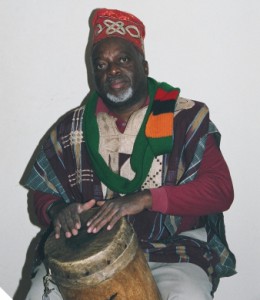
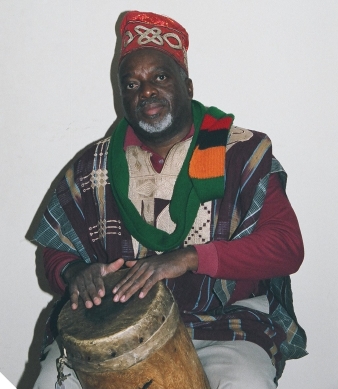
Prof. Tembo regards the African drum as representing some of the most fundamental deeper aspects of Zambian and African traditional culture. He has done storytelling of Zambian folk tales and drumming to audiences in the United States.

Prof. Tembo regards the African drum as representing some of the most fundamental deeper aspects of Zambian and African traditional culture. He has done storytelling of Zambian folk tales and drumming to audiences in the United States.

a young boy to live at Chipewa Village at my mother’s village in Lundazi among the Tumbuka people. I lived with my grandparents Mateyo Kabinda and Esilete Nya Mwaza. Living in the village was like being in heaven on earth. My father’s village, Seleta, was about one kilometer away. Between the two villages  I lived among six hundred loving relatives.  I lived among my grandparents, uncles, aunts, numerous cousins, and many people from other clans. All of the people loved me.

We ate nshima with nchunga ziswesi or red kidney beans, peanuts, pumpkin leaves, or mphangwe vegetables with peanut powder, delele, peas, pumpkins, chicken, goat meat, and wild meat when adult men when on hunts in the dry season. There was plenty of food as my grandparents were great subsistence farmers. As children we went to the bush and fetched fruits such as futu, nthumbuzgha, masuku,  kasokolowe, mbulimbunje, and nchenja. We dug mice and killed small birds. We swum and fished in the cool swift fresh waters of the Lundazi River and Denkhule creek. During the bright savannah moonlight at night we would listen to vilapi or folktales or play hide and seek. My cousin James Kabinda and I were charged with herding the family goats. Every day was  so full of drama and adventure until one day my uncle called me to take me to school for the first time.

Going to School

My uncle took me to school one afternoon to start Sub A or Grade I at Boyole Primary School in 1960. When my uncle let my little hand go to walk into the classroom, our teacher Mr. Mbuzi welcomed me and told me to squeeze between some of the students on the few desks. The class had about 40 students. The teacher was drawing a big snake on the black board as I joined the class in singing:


Chinjoka chikulu chikamnyenga Adam

Adam na Eva


A big snake tempted Adam

Adam and Eve


This was a religious knowledge class. That’s started what was to be along academic career. That same year my mother came and got me so that I could join the family at my father’s first teaching assignment after his teacher training at Katete Mission. We lived at Chasela Primary School among the Bisa people for two years before my father was transferred. The thing I remember the most from Chasela are the friendly people but especially wild animals. Every day when I woke up I could see elephants, giraffes, monkeys, Impalas, large herds of buffaloes all roaming freely everywhere around my house. I cannot believe today that there are so few animals in the same Luangwa Valley where I lived 53 years ago.

My father taught at Mafuta School, Dzoole School, Kapongolo School, Kasonjola, Gundani and Mnoro school.

Challenges of School and Education

I was never always the most intelligent as I gained my education. But what my grandparents and parents taught me was to work hard at everything just as we did when we woke up every day early in the morning during the rainy season to work in the field with a hoe to grow food. My parents instilled in all of us 9 children; 6 girls and 3 boys the value of hard work, tenacity, and endurance. The best gift my parents gave us is by example to teach us to be kind, generous, and compassionate, to enjoy laughter, and to share what we have. But my parents also taught us to be tough, assertive, and to always defend ourselves. Being soft, to be paralyzed by fear or katelu was not allowed in our family among all the girls and boys. My mother had a saying that I always remember: “Mwana wolera nge ni botolo yayi”; meaning “You do not raise a child like a delicate bottle that is going to break any time you drop it.”
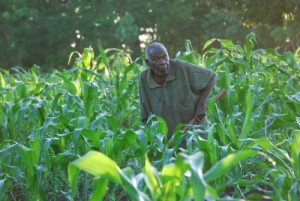
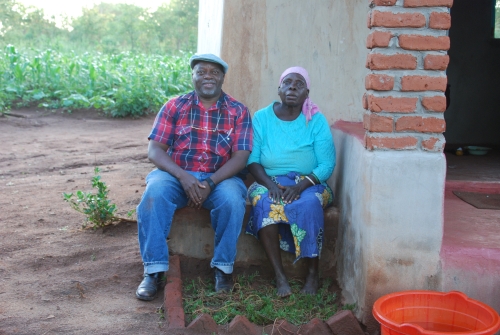
 Dr. Tembo’s father Mr. Sani Tembo who is 89 years old is still active and works hard hoeing to grow food. This was in December 2011

Dr. Tembo’s father Mr. Sani Tembo who is 89 years old is still active and works hard hoeing to grow food. This was in December 2011

When my father was teaching at Mafuta School, Dzoole School was burned down in 1962 in an arson attack as the African National Congress (ANC) led by Harry Nkumbula and the United National Independence Party (UNIP) and Zambians defied, struggled and protested British colonial rule.  My father was assigned to go and reopen the school as he worked with the Parents Teachers Association (PTA) to rebuild the school. My father opened grade one as he taught the class under the shade of a huge Kachele tree. Since Dzoole Primary School did not have Standard II or Grade 4 yet, my father arranged that I attend a weekly boarding at Rukuzye Primary School which was 15 miles or 24 Kms. away and I was only 9 years old. Every week for 6 months in 1963, my mother packed me food for the week in  a small carton box. I went to that school on Sunday riding my mother’s bicycle and came back every Friday.
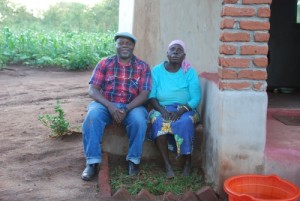
Dr. Tembo with his mother A Enelesi Kabinda or a NyaNthula in the village in Dec. 2011

Dr. Tembo with his mother A Enelesi Kabinda or a NyaNthula in the village in Dec. 2011

In January 1964, I was accepted to attend Standard 3 or Grade 5 at Tamanda boys Upper Boarding  School. This was a Dutch Reformed Mission Church Mission School on the remote border with Malawi. The first night I cried all night because I was away from home among some hostile students as mockery was very intense. But I remembered what my parents told me about the importance of education for my future and that of my family. My education at Tamanda was the best. I had some of the best teachers. The ones I remember are my English teacher and Headmaster Mr. Elisa Phiri, my brother-in-law who married my sister, Mr Lyson Mtonga, and Mr. Khondowe.

Something happened to me and my family that had a profound effect on my entire life. It was during the late afternoon of manual work at Tamanda Mission Boys Upper Boarding School. I was performing manual work sweeping the dusty school yard excitedly chatting with a detail of fellow students when a student walked to the group and told me the School Headmaster Mr. Phiri wanted to see me immediately in his office. My fellow students were surprised because I was not a typical trouble maker who broke school rules. I had been called to the Headmaster’s office once under some minor disciplinary circumstances where a received a stroke of the cane. But that was a year before. I was surprised too and wondered what I might have done wrong this time that I was not aware of. The Headmaster was well known for being a strict disciplinarian and for his stern red eyed chain smoking look. He freely used corporal punishment when necessary. I walked to his office with trepidation.

I softly knocked on his office door and a deep voice asked me to come in.  I stood at attention as without any fanfare the Headmaster raised his head from his paperwork on his large desk and said: “Mwizenge, I just received a message from your father that your younger brother Leonard passed away last week. The message didn’t say what you brother died of.  I am sorry.” The large clicking clock to the Headmaster’s desk showed 16.00 hours or 4:00pm June 14, 1966. I was 12 years old and my world had just fallen apart.

I was in shock and stunned. I don’t remember how I walked from the Headmaster’s office to my dormitory bed. I lay in my bed and I could not stop crying. When dinner time came, I could not walk to the dining hall. Another student brought my dinner and put it by the side of my bed. Students continued with their boarding school routine. They had to go to the classroom with the only paraffin lamp that had enough paraffin for studying and doing homework  from 19:00 hours or 7:00 pm to 21:00 hours or 9:00pm.

The entire large dormitory  with 60 beds was quiet and pitch dark. I cried as images of my little 7 year old brother flashed before me especially the last time I had seen him barely three weeks before as I was leaving for  my boarding school early that morning. I played soccer with him as he tried to get the ball away from me. He was crying and running to get to the ball but each time I would kick it away as he yelled for help from mother. My mother yelled for me to give the ball to my crying little brother as I was leaving soon. My father was to escort me riding our bikes ten miles to the bus station at Lumezi. I gave the large soccer ball to my little brother who held it with both hands with a triumphant look on his face as I rubbed his head and walked away. My brother was now gone. I would never see him again.

My covers were drenched as tears poured from eyes. In the pitch dark dormitory room I heard footsteps and a voice. A student said the Headmaster wanted me to go to his house immediately. I walked the two hundred yards to the Headmaster’s house and knocked on his door.

The living room looked comfortable with nice cushions and sofas. He asked me to sit down in one of the sofas. My eyes were wet and red from non-stop crying. His young wife who had a baby on her back walked in from the kitchen with a teapot and some cups of tea. She served me some tea.

As the yellow kerosene lamp flickered, the Headmaster told me in a much softer voice I had never heard before how he was sorry about my brother’s death. He urged me to stay strong. He said I would be going to see my mother and father and family in six week times during the school holidays. Besides, soon I would be sitting for the most important exam in my life: the Secondary School Entrance Exams. He urged me to stay strong in life.

We sat quietly for may be twenty minutes and then he told me to go back to the dormitory.

Going to church twice per week and being a member of the church school choir were some of the best memorable experiences. I had so many friends and class mates including Michael Ngulube, Elliot Tembo, John Jere, Shuward Shawa, Leornard Phiri, John Mbewe, Yandikani Nkhoma, and the student who had very serious stuttering Malilo Ngwira.

Chizongwe Secondary School
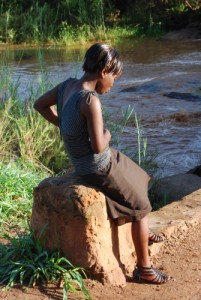
My niece Ruth Tembo waiting for a bus near our village on our return to Lusaka in December 2011

My niece Ruth Tembo waiting for a bus near our village on our return to Lusaka in December 2011

The Tamanda Upper School Grade 7 class of 1966 had 40 students; only 14 of us qualified to go to secondary school. I was among about 6 students from Tamanda who reported for Form I at the prestigious Chizongwe Secondary School in January 1967 in Chipata. It was very challenging as all the Form One students were the best from the whole province. The next 5 years at Chizongwe were probably one of the most important. I made tremendous strides in learning in such subjects as Mathematics, Geography, English Literature, Physics, Chemistry, Nyanja, and Technical Drawing. I made lifelong friends and also met some of my best teachers who inspired me. Mr. Newton, a British teacher, told me I could do Physics  and Chemistry when I did not have the confidence. Some of the teachers were Mr. Parkinson, Mr. Ad Hordyk, Mr. Bailey, My Geography Teacher Mr Milroy,  and Miss Keon.

The most inspiring was probably our Principle Mr. J. S. Mei who was a disciplinarian who had the best of sense of humor. Every student from Chizongwe has a J. S. Mei story especially when we had a near student riot among Form Four and Form Five students in 1967. The Chipata Mobile police had to be called to campus for a day to quell tensions.  Because Zambia lacked man power just after independence, the 22 teachers at Chizongwe were all European and Mr. Chirwa was the only Zambian teacher. I feel very lucky that Mr. Chirwa taught me and I learnt to write Nyanja because knowing that Zambian language is as significant or important as learning English. I found this out later in life in the 1980s as I began to conduct research as a scholar at the University of Zambia and now in 2013. Some friends form the 1971 class are Ben Kalinda, Kennedy Ngoma, Michael Ngulube, and Abdul Munshi.

The testosterone soaked teenage life of a Chizongwe Secondary School male student is consumed with thinking and dreaming about the beautiful girls of St. Monica’s Secondary School whose school was just over the mountain in Chipata. One classmate who will remain nameless even wrote a romantic poem about St. Monica’s girls which we published in the school newspaper. I can attest to this because I was on the editorial board for the school newspaper at the time in 1971.

University of Zambia Students Union (UNZASU) led students held a political demonstration and marched from the Great East road Campus to the French Embassy which was located on Freedom Way downtown Lusaka. The students were demonstrating against France selling Mirage Jet Fighters to the then Apartheid South Africa. Those jets were going to be used to support the regime as it bombed ANC bases in the front lines states. The young Zambian State and Police force may not have known yet how to handle public student demonstrations. The police tried to disperse the students using clubs and tear gas.   There was commotion as the students fled and  scattered some running through Cairo Road dodging through stunned busy Cairo Road shoppers with button totting  police in hot pursuit. One fleeing student was shot in the behind apparently because a police officer accidentally discharged his fire arm. There was a huge controversy in the national press and government about the handling of the student demonstration. Fortunately no lives were lost and no one was seriously injured.

When the sensational news reached our school, we were all intrigued as we excitedly discussed the events in our dormitory in Aggrey House. We knew some of the names of the  UNZASU students who had just gone to UNZA the previous year from Chizongwe. I never realized I would be at UNZA that following year and participating in student politics.

The 1971 From V class at Chizongwe had 65 students. I was among the top  6 of us who  qualified to go to University of Zambia for our Bachelor’s degree in 1972. The competition was very stiff as the freshman class could only admit 350 of the best students from thousands of Form V or Grade 12 students from all secondary schools in Zambia.

University of Zambia

I will never forget my first day at University of Zambia. I was in African Hall 5 Room 26. I stood on the balcony and could see the beautiful green lawns and flowers around the residence hall. The 3 dining halls served 5 course meals including soup, rice, meat, vegetables, cake with custard, bread, tea or coffee with milk. Zambia had so much money that we used to get some of the left over bread and feed it to fish at the Goma Lakes during evening straws on campus.

I had always wanted to major in Psychology. In my own secondary school mind I mistakenly thought psychology would teach me how to read people’s minds. My most influential teachers were Professor Robert Serpell and Professor Muyunda Mwanalushi. The first year was intellectually exciting for my young mind. I learnt about the scientific method, psychology experiments, conducting sociological researching in neighboring Kalingalinga compound, Introduction to Political Science, Sociology, and Psychology. English class exposed to the powerful “Autobiography of Malcolm X”. https://hungerforculture.com/?p=265

We wrote papers about the different intellectual arguments about the establishment of One Party States in Africa at that time in 1972. As first year students, many lecturers emphasized that our lecturers did not have a monopoly on knowledge contrary to our secondary school belief that the teacher knew everything and was always right. As freshmen students, we were urged to scrutinize, critically evaluate, question, challenge existing assumptions, assertions, theories, models,  and epistemologies through the gathering of empirical data. I took all this to heart up to this day.

One thing I found very disturbing was that as I wrote research papers, none of what I knew from my Tumbuka indigenous African cultural alternative perspectives appeared in any of the research papers, journals and books that I read. I asked myself why? All of it seemed to have been published by Europeans. Most of it described African culture as primitive and backward. I never believed that all the people who lived in my village were primitive and backward. The lecturers insisted that we only use in our papers only material that had been published. That troubled me greatly. This is probably why I have ended up devoting my entire adult life doing original Zambian and African field research.

As liberation wars were raging in Angola, Mozambique, Namibia,  Zimbabwe, as well as the struggle against apartheid in South Africa in 1975, radical Marxism caught  fire among lecturers and students on the University of Zambia. The University of Zambia Students Union (UNZASU) led frequent demonstrations which culminated into campus protests, marches, near riots that led to the closure of UNZA and the brief detention of some students in February 1976. Some my best friends from the 1976 class are Dr. Vincent Musakanya, Dr. Stanley Mwila, Dr. Chisanga Siame, Dr. Fred Nga’ndu and Ms. Sophie Ng’andu, the late Dr. Irene Maimbolwa,  Mr. Tom Mubita and Dr. Poonam Groover.

Graduate School Masters and Doctoral Degrees

After I graduated from UNZA with a double major in Psychology and Sociology in 1976, I briefly worked with the National Agricultural Marketing Board (NAMBOARD) for 3 months as a Training Officer. One of my most memorable assignments is when I was sent to visit and write a report on all the dozens of NAMBOARD depots in the Western Province. I flew Zambia Airways to Mongu. The Mongu NAMBOARD official, a driver, and a brand new Land Rover were waiting for me at the airport. That’s when for the first time in my life I realized we have such a beautiful country and great people. I visited Kaoma, Lukulu, Senanga, Sesheke, and we crossed the vast dry sandy Zambezi flood plain on our way to Kalabo.

The University of Zambia and the brand new Staff Development Program invited me to join under the Sociology Department. Professor Robert Serpell and Professor Mwanalushi invited me to join them as a Research Assistant on the “Community Response to Alcohol-Related Problem” project sponsored by the World Health Organization (WHO). The project was housed at the Institute of African Studies of the University of Zambia at the time. The same institute is now the Institute of Economic and Social Research (INESOR). This is how I became a Staff Development Research Fellow at the Institute while also affiliated with the Sociology Depart or the Social Development Studies as Staff Development Lecturer. Conducting both some teaching and doing field Research was what I had dreamt of most of my academic years at UNZA.

At the Institute I was to work with Directors such as Prof. Kashoki, Dr. Steven Moyo, Prof Serpell, and Professor Oliver Saasa.

The Staff development Fellowship program was probably one of the most innovative in Zambia if not the whole of Africa. The government of Zambia by 1975 had noticed that there were very few or hardly any Zambians on the faculty of the young University of Zambia. To improve the Zambianization process, the program was put in place in which every year from 1975, the best one or two graduates from all departments or majors were going to be selected. They would be offered scholarships abroad and trained to do their Masters and Doctoral Degrees. After completion they were to return to University of Zambia to become our Zambian indigenous lecturers.

I Meet My Wife

I arrived at Michigan State University in East Lansing in Michigan in the United States in September 1977 to do my Master’s and Doctoral Degrees in Sociology. As soon as I stepped out of the plane, all the euphoria, anticipation, and excitement I had enjoyed among my family and friends in Lusaka at many farewell parties abruptly ended. The place was colder than anything I had ever experienced in the coldest month of June in Zambia. I was told the worst in the winter was still to come. I did not like the food, it was too cold, my friends and family were thousands of miles away in Zambia with no phones at the time. Letters took months.

Dr. Peter Manchungwa was there the first day to show me the ropes. He was at the time doing his Ph. D. in psychology. I experienced major culture shock and loneliness. I took so many course credits because I had nothing to do except study. My American classmates were shocked I was carrying such a heavy load of 12 graduate credits when the average was 5. My thinking was the Zambian government was paying for my tuition and board, I did not want to waste precious time. Besides I was used to studying and working hard since I was 9 years old.
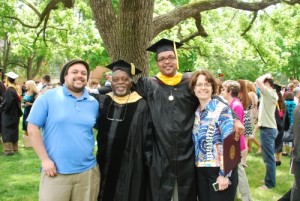
Graduation day for my son; from left to right: my Son Temwanani Tembo, Dr. Tembo, Sekani Tembo and Beth Tembo

Graduation day for my son; from left to right: my Son Temwanani Tembo, Dr. Tembo, Sekani Tembo and Beth Tembo

One day I causally met this white American girl at our African party. We hit it off and sparks flew as we were very attracted to each other. Our love was living proof to me that love cuts across human taboos and barriers. Years later in November 1980 amidst a night curfew because of an attempted coup, we were married in Lusaka at the St. Ignatius Catholic Church in Rhodes Park in a small private ceremony before about 15 of our closest friends and my uncle Mr. Mayovu. We were young and I was poor and broke. That’s how we started our lives together.

We are blessed with two large united

My son Sekani Tembo graduating from Bridgewater College with a Bachelor’s Degree in Computer Science and Philosophy in May 2012.

My son Sekani Tembo graduating from Bridgewater College with a Bachelor’s Degree in Computer Science and Philosophy in May 2012.

families in Zambia and the United States. The family rendezvous in Lusaka is my uncle and aunt at Mr. J. J. Mayovu’s house in Lusaka in Chainda farms. I would arrive with my children there on our way to  our remote home village in Lundazi. My wife and I are proud that our 3 children know their roots here in Zambia all the way to the village. They all have Zambian names.

Intellectual and Academic Life

I completed my Doctoral Studies at Michigan State University in 1987 with the late Prof. Ruth Hamilton as my Doctoral Committee Chair. I returned to Zambia with intentions of my working at University of Zambia the rest of my life. After 30 years of an exciting, challenging, research, teaching and intellectual life,  Bridgewater College awarded me a full Professorship in February 2010.

If I were to perform a bird’s eye view of my life achievements spanning over five decades since the early 1960s, the first thing is that I am everyday so profoundly grateful to the Zambians who fought for me to enjoy the tremendous freedom and especially the free education I had all my life. I thank President Kaunda, Simon Kapwepwe, Harry Nkumbula, Titus Mukupo, Julia Chikamoneka, Nalumino Mundia, Munukayumbwa Sipalo,  Reuben Kamanga, Dingiswayo Banda, Justin Chimba, Mainza Chona, Peter Matoka, Elijah Mudenda, Simon Kalulu, Nalumino Mundia,  John Mwanakatwe , Munukayumbwa Sipalo, James Skinner, Arthur Wina, Sikota Wina , Grey Zulu; Lewis Changufu  and Aaron Milner. Without the efforts, sacrifices, and determination of these and many other thousands of Zambians, I may have experienced slavery, the harsh colonialism of forced labor and being lashed with a shambok. We Zambians and Africans have had over hundred long years of being enslaved through the European Atlantic Slave Trade and the Arab East African slave trade. Then there was European colonialism. There is a picture that has haunted me since I first saw it in my history textbook class in Grade 6 when I was 11  years old one bright morning at Tamanda Primary School in 1965. It is a group of Zambians in a single file chained together some with wooden collars around their necks. They were captured as slaves and being brutally marched through the Savannah bush to an East African Sea port by their Arab captors. My thinking at that time was that the enslaved suffering people could have been me, my father, my brothers, my sisters, my grandparents in the village. This appalled me and wondered why any human being would do such evil things to other human beings.

In my whole life, I have never been interested in routine administration leadership. My passion has been conducting research, dealing with, analyzing,  and contemplating philosophical thought. I know I am happy other people purposefully seek, welcome and perform these challenging administrative tasks otherwise I would have no work because someone has to lead and perform administrative jobs. Otherwise I might have no well-run organization or Bridgewater College to work at. Because of this lack of interest, my resume does not have too many having been “Head, Dean, Director, or Chairman” of this or the other organization, Department, Company, College or University.

The organization I am most proud of is being President of Zambia Knowledge Bank (ZANOBA). I had been looking for something very original and important to promote knowledge among our Zambian people. Dr. Wyndioto Chisela, a Physicist,  and I met in Canada in 1995 when my family visited his family. We came up with the idea of creating an organization to encourage  Zambians to document our history, culture and technology. This organization eventually built a Library at Nkhanga Village in Lundazi which opened to the public December 8, 2012. http://www.bridgewater.edu/zanoba/menu/updates/2012LibraryOpened.shtml

I conducted research field work while at the Institute of African Studies from 1977 up to 1989. Some of that work resulted into the publication of truly original Zambian and African knowledge in my four books: Satisfying Zambian Hunger for Culture (2012) with the Foreword by President Kaunda for which I am very grateful. Titbit for the Curious (1989), Legends of Africa (1996), The Bridge (2005, 2012), and Zambian Traditional Names (2006). I had always wanted to be a journalist. I have published over a hundred newspaper columns, dozens of journal and magazine articles about our Zambian culture.

I taught sociology and psychology at Copperbelt University in 1980. I also taught sociology at Michigan State University while I was a Doctoral student from 1985 to 1987. I taught sociology at University of Zambia in the Social Development Studies department from 1987 to 1989. I have
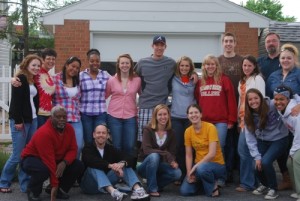
Dr. Tembo with Faculty and his Sociology students at Bridgewater College in Virginia in the United States in May 2011

Dr. Tembo with Faculty and his Sociology students at Bridgewater College in Virginia in the United States in May 2011

been teaching at Bridgewater College in Virginia in the United States for the last 23 years. I have taught General Anthropology, Social Problems, Racial and Ethnic Studies, Cultures of Africa, Development and Underdevelopment of the Modern World, Principles of Sociology, Personal Development Portfolio, Sociology of the Caribbean: A Case Study of Jamaica, Quantitative Research Methods using the SPSS and Mystat Computer Program and (National Opinion Research Center) NORC data, American Culture Seminar, Sociology of the Family, and Criminology. I have also done some quiet extensive scientific reading on the science of HIV-AIDS, disease, and the immune system since the disease’s inception in the early 1980s.

Although I have had all this large volume of knowledge about societies, Zambians and Africans  over many years , my world view was changed dramatically in May this year when I first read Dr. Chisanga’s Siame research article: “Katunkumene and Ancient Egypt in Africa” from the Journal of Black Studies of 20 March, 2013. My world view changed permanently and forever. The challenge is:  “Can we change this world for the majority of 13 million Zambians and then 1 billion Africans?” I did not come to this realization just because I read a short journal article, ate nshima and drank a cup of tea and then said: “Let me think how I can upset so many educated and ordinary Zambians?”

Because of all the knowledge, appreciating history, personal experiences from the village in Zambia to the United States, research, reading so much information and teaching some of it for the last 30 years, I have concluded that we Zambians, from the Ministry of Education Grade One  to grade 12 to University of Zambia, we are teaching the wrong or distorted history to ourselves about ourselves. Our history as Zambians started  a long time ago from two hundred thousand years ago when we were the first humans in East Africa and Ethiopia. We spread all over the world. The evidence of us having been all over the world is all over the world right now. We just need to have the courage and conviction to find it and interpret it to the world. Europeans used to and have successfully blocked this knowledge but the internet will open the flood gate.

After early humans lived and migrated in small bands and communities for thousands of years, We Zambians and Africans created the Egyptian civilization. The arguments as to whether Egypt had white or black people may be irrelevant and it is a deliberate distraction, mifulungenye (Bemba),  msokonezo(Nyanja) kutangwaniska and kujalizgha (Tumbuka), or obfuscation that Europeans cherish which they introduced to justify the beginning of the Atlantic Slave Trade and later European colonialism in Africa. They love to inject race into everything with whites always being superior somehow. African Egyptians in the north were olive skinned and those further south towards the equator were darker skinned.

The Egyptian civilization occurred for 2,010 or more than two thousand years from 3100 B.C.E to 1090 B.C.E. This was about 760 years before the ancient Greeks. The great Ancient Egyptian Civilization which African established was 2,460 years before the very young European Industrial Revolution of the 1700s and 1800s. The 1090 B.C.E to 2013 is 3, 013 years ago. Dr. Siame’s article opened my eyes to the fact that using linguistic analysis known as  philology, and then the morphology, phonology, semantics and syntax of language you can trace “Siame” Namwanga Zambian name to the Pharaohs of ancient Egypt three thousand years ago. http://ukzambians.co.uk/home/2013/06/01/zambians-created-ancient-egypt/

The big question is why should our history books still contain only the Eurocentric history that says that our Zambian history is only significant from the 1600s when Europeans started the Atlantic Slave Trade and 1800s when European Colonialism started in Africa?  At first for example, the Eurocentric history of my own Tumbuka people said we were just there in Lundazi influenced by the Ngoni and Europeans. But Dr. Yizenge Chondoka’s intensive research and history shows that the Tumbuka came from Central Congo in the 1400s. This is from his book: History of the Tumbuka from 1400 to 1900 (2007). https://hungerforculture.com/?p=259

As a Zambian you may have your own different convoluted half-truth version you read or were taught somewhere about how Africans are different people who have thousands of different tribes and languages. The real objective in using “Sub-Saharan Africa” is European attempt to Europeanize, whiten, and distance Africans from Egypt, Southern Europe and the Middle East. But one thing is clear: there is ample evidence now coming out that we should change and revise this history that wrongly portrays all Zambians, Africans, black people everywhere in the world as inferior, came from slavery, or were just sitting in the African jungle or bush jumping for tree to tree until Europeans arrived. This is a massive distortion and suppression of our history since the Greeks first encountered advanced civilization of Egypt three thousand years ago.

We have had some scholars in Zambia who have done some definitive work on Zambian history and knowledge. For example, Prof. Robert Serpell for more than 40 years has been using modern psychology to analyze our Zambian culture and technology, The Significance of Schooling (1993). https://hungerforculture.com/?p=547.

Dr. Mutumba Mainga Bull researched; Bulozi Under the Luyana Kings: Political Evolution and State Formation in Pre-Colonial Zambia (1973), Professor Mubanga Kashoki published Sirarpi Ohannessian and Mubanga E Kashoki, Language in Zambia (1978). There are many other works. There are some works by European scholars such as Elizabeth Colson among the Tonga. This is not  the fault of these scholars. But some of these works go beyond the narrow confines of the Eurocentric view point but some do not.

This is the time to begin conducting wider research  that traces our Zambia history not just of culture and technology in the narrow tribal  pejorative sense but looking at our role in Astronomy, Engineering, biology, Mathematics, religion, philosophy, technology, architecture, chemistry, biology, cosmology, and language.

Last Word
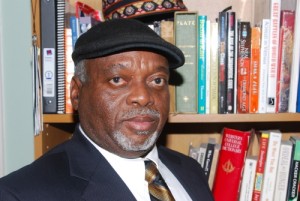
Dr. Tembo on the day he was Promoted to Full Professor in February 2010.

Dr. Tembo on the day he was Promoted to Full Professor in February 2010.

  • My dream is that every Zambian  from Mongu to Kasama, Kafulafuta to Kalingalinga in Lusaka, Kariba, Sinazeze, Chililabombwe, Solwezi, all Primary, Secondary schools, University of Zambia and Vietnam, Japan, China, United States and UK should read, use, and contemplate our comprehensive cultural history as presented in the book: “Satisfying Zambian Hunger for Culture”.  https://hungerforculture.com/?page_id=242

Even our Ministry of Foreign Affairs and Embassies abroad could use this book. There is no other book that has such comprehensive descriptions of our Zambian culture. I tried to reach State House last December 2012 to see if I could deliver the  book personally to the President at State House when I was in Zambia. But I was unable to make the arrangement.

  • One of my most important passions for many years has been to help President Kaunda to
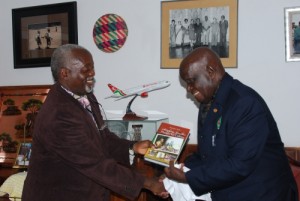
    Dr. Tembo handing a copy to President Kaunda a copy of his book: “Satisfying Zambian Hunger for Culture”. The President wrote the foreword to the book.

    Dr. Tembo handing a copy to President Kaunda a copy of his book: “Satisfying Zambian Hunger for Culture”. The President wrote the foreword to the book.

    write his autobiography from 1964 to 1991 during the crucial birth of our nation. This is very important especially that Nelson Mandela is gone. If you read the book “Satisfying Zambian Hunger for Culture” you can see that I can do the best job in writing President’s Kaunda’s autobiography. Writing an easily readable, enjoyable,  and engaging autobiography requires tremendous skill. It should never be like writing a technical report. I can do this for nothing although I am relatively poverty stricken.  But his autobiography would be President Kaunda’s biggest gift to our country.
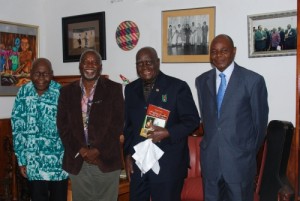
    From left to right after presenting the book: “Satisfying Zambian Hunger for Culture” to President Kaunda; Mr. Mfula, Dr. Tembo, President Kaunda, and Mr. J. J. Mayovu.

    From left to right after presenting the book: “Satisfying Zambian Hunger for Culture” to President Kaunda; Mr. Mfula, Dr. Tembo, President Kaunda, and Mr. J. J. Mayovu.

  • I am proposing that we create a “Center for the Deep Contemplation of Knowledge”. This center should be located in a remote Savannah serene but beautiful location away from the bustle of the city. This is where Zambians can spend quiet time  to retreat and  contemplate any knowledge they have. This will not be a University, technical R and D, a place to hold workshops, or a place to use alcohol and hold parties. We already have those. This is where serious Zambian men and women, who would be at least 35 years old, can seriously deeply reflect in a serene location all kinds of knowledge: History, Law, Literature, Performing and creative  Arts, Philosophy, Religion, Linguistics including and especially Zambian languages, Culture, Economics, Gender and Sexuality, Psychology, Sociology, Political and philosophical science, Computer science, Mathematics, Statistics, Agriculture, Architecture, Divinity, Engineering, Physics, Astronomy and Space, Cosmology, Chemistry, Biology, Medicine. Some of the disciplines such Anthropology have been so contaminated, we should never hesitate to create  new disciplines where necessary. Merely repeating or extending epistemological theories that were developed 200 years ago may no longer be useful or give us good explanations or answers as the world continues to change and evolve.

References if Readers want to pursue some of the ideas and knowledge.

Anta Diop, Cheikh., edited and translated by Mercer Cook., The African Origin of Civilization: Myth or Reality, Chicago: Lawrence Hill Books, 1974.

Bernal, Martin., Black Anthena: The Afroasiatic Roots of Classical Civilization, Vol. III, Linguistic Evidence, New Brunswick, Rutgers University Press, 2006.

Bernal, Martin., Black Anthena: The Afroasiatic Roots of Classical Civilization, Vol. I, The Fabrication of Ancient Greece 1785-1985,  New Brunswick: Rutgers University Press, 1987.

Lefkowitz, Mary., Not Out of Africa: How Afrocentrism became an excuse for teaching myth as history,  Basic Books, 1996, 19997.

Rodney, Walter., How Europe Underdeveloped Africa, Washington, D. C.: Howard University Press, 1974.

Bynum, Bruce., (Ed.) Why Darkness Matters: The Power of Melanin in the Brain, Chicago, Illinois: African American Images, 2005.

King, Richard D., Melanin: A Key to Freedom, 3rd Edition 7th Printing Sept. 2011 Baltimore: Afrikan World Books, Inc., 2010.

King, Richard, M. D., African Origin of Biological Psychiatry, Baltimore, Maryland: African World Books, 199o.

Moore, T. Owens., The Science and the Myth of Melanin: Dispelling the Rumors and Exposing the Fact,  Buffalo, NY: Eworld Inc.,  1995, 2002.


http://en.wikipedia.org/wiki/Africa

http://en.wikipedia.org/wiki/Lucy_(Australopithecus)

http://worldpopulationreview.com/population-of-jamaica/

https://en.wikipedia.org/wiki/Recent_African_origin_of_modern_humans

https://en.wikipedia.org/wiki/File:Map-of-human-migrations.jpg

http://www.ezilon.com/maps/oceania/papua-new-guinea-physical-maps.html

http://www.ancestry.com/name-origin?surname=banda

http://www.virginia.edu/woodson/courses/aas102%20(spring%2001)/articles/tierney.html

http://www.asante.net/articles/19/race-in-antiquity-truly-out-of-africa/

https://en.wikipedia.org/wiki/Atlantic_slave_trade

http://en.wikipedia.org/wiki/Dark_Ages


December 17, 2013
My son Kamwendo Tembo when he graduated from Culinary School at Oregon Coast Culinary Institute in the United States.
My son Kamwendo Tembo when he graduated from Culinary School at Oregon Coast Culinary Institute in the United States.


My son Kamwendo Tembo with his mother  Beth Tembo in Coos Bay in Oregon in the United States in Aug. 2012.

My son Kamwendo Tembo with his mother Beth Tembo in Coos Bay in Oregon in the United States in Aug. 2012.
The Double Life of Billy Tipton

The Painful Problems of Biological Sex and Gender in Society

Since feminist scholars identified the critical difference between biological sex and the cultural construction of gender, heated arguments have been evident. Radical feminists have argued that sex differences are a biological reality that are perhaps only necessary for reproduction. Gender differentiation and social construction into the two exclusive categories of “man” and “woman” however, are not only arbitrary but their stereotypical proscriptions serve to stifle both men and women’s lives. This prevents both men and women from achieving sexual equality and realizing their full potential in society. Radical feminist scholars have further advocated gender-neutral socialization of males and females in societal child rearing practices. The proposed solution is often advocating androgyny during child socialization in society. These assertions suggest that gender may be roles that anyone can play and successfully act out or perform irrespective of the biological sex of the particular individuals. Could this actually be the case?
What if a human being was born biologically female, raised as a girl, during late teenage she decided to become a man and lived the rest of his life that way as a man? This would be a challenging but not an unusual Hollywood movie plot. But the astounding twist to this story is that it did happen in real life. The circumstances in which this human drama unfolded stretched over seventy-five years.

In “Suits Me: The Double Life of Bill Tipton,” Diane Wood Middlebrook describes the life of Jazz Performer Bill Tipton. His death in a trailer park in Spokane Washington, at the age of seventy-five years in January 1989, drew worldwide attention. This was not just because of his music, but when paramedics who had been summoned to attend to the dying Tipton discovered that he was a woman. An autopsy later confirmed that Billy Tipton was a woman. The reader’s immediate reaction might be that this is impossible.

Some of the immediate questions that arise include: how did his family and friends react to his changing from being a woman to a man? How did it happen and why? How could he have been married to several wives and have children too? How did he play his role of husband and father? How did Billy and his wives have sex? Since he spent most of his life on the road with many Jazz bands as a performer, how did he conceal the secret that he was biologically a woman? Most of all, how did he pull this whole stunt up to his death?

In the three hundred and twenty-six pages of the book, Middlebrook integrates the fascinating puzzle of the double life of Billy Tipton. Since Billy did not have a diary and had no inclination to reveal the secret, the author had a difficult task of conducting numerous interviews and looking at scrap books to recreate as closely as possible the early life and experiences of Dorothy Tipton and the later life of Billy Tipton.

Sociologists often engage in ethical debates and speculative analysis regarding human experiments. The classic one is: “Should a social scientist raise a child in total isolation to determine the impact of isolation and therefore to determine the necessity for socialization?” The answer is always no. Parallels can be drawn with the story in this book. A human being was born anatomically female, raised as a girl but later decided to become and lived her entire life as a man. The life of this one person provides a rare opportunity to investigate and validate the power and complexities of gender, socialization, and impact of social change in society.

The story of Billy Tipton challenges the society’ notions of gender role socialization especially the rigid dichotomy of man and woman. It demonstrates what can happen when factors such as family instability, poverty, rapid social change, individual ambition and a yearning drive for excitement can all combine to drive human beings to do the unusual and extraordinary. Billy Tipton’s life may suggest and confirm that gender is not only a social construction but the way humans live their lives may be entirely acting or like roles that actors play on a stage. This is the classic Goffman’s dramaturgical approach.

Nielsen says: “Which is more interesting – knitting or burglary? The idea of a woman committing a burglary has a certain bold flavor that a man’s knitting does not. …The comparisons suggest that there are advantages connected with the traditionally male activity, the so-called male job, or the male role that are not part of traditionally female activities, jobs, or roles.” (Nielsen, 1990:5) Nielsen suggests that men’s gender roles have higher status, power, privilege, and especially adventure. When Dorothy started to play music in Jazz bands, women Jazz musicians were neither respected not given the opportunity to excel.

This book provides a rare and unique opportunity to perhaps empirically test some of the propositions that arise out of the gender-neutral hypothesis. Parts of the story pose some critical challenges that seem to confirm what radical feminists have asserted for several decades; men’s gender accords them higher status, power, privilege, more choices, adventure, and more freedom.

Faced with a dysfunctional family, grinding poverty, limited options as a young teenage woman who barely finished high school, she becomes a man playing in jazz bands. She does this without radicalism and with no pomp and ceremony. Other men gradually accept her as a man and she enjoys with them the high status and incredible men’s comradely and banter including dirty jokes. It is apparent that it must have been physically and psychologically very difficult for Billy Tipton to conceal the biological reality that he was a woman.

When interviewed after his death, some of his previous wives expressed views that are philosophically challenging. One of the former wives said that Billy was a loving, kind, caring, and very supportive husband. The wife experienced sexual intimacy with Billy as her man, lover, and husband. In spite having had essentially positive and fulfilling experiences with Billy, some of the wives felt betrayed. The question that arises is whether “gender role” is something that is so neutral that anyone should be able to “act it” like one is on a stage? If gender was entirely disassociated with biological sex, would it matter if a husband was not biologically male or wife was not biologically female? Were the feelings of betrayal that some of the people who had intimate relations with Billy Tipton felt, entirely a product of societal expectation through socialization?

The book challenges many of the fundamental assumptions about the relationship between gender socialization, gender role-expectations, and social change in American society. One missing ingredient that would have perhaps precluded any lengthy theoretical speculation about Billy Tipton’s motives for living this was is Billy’s opinions. Since he seems to have been completely committed to living as a normal man, he never kept a diary or confided in anyone about how it felt like to live like a man. It is not possible to determine why she chose to be a man. This reconstruction of Dorothy and Billy Tipton’s life is what must have made the book so difficult for Middlebrook to write.

Suits Me: The Double Life of Billy Tipton is excellent for general readership. But it provides rare infinite resources for teaching American history of Jazz and music, the challenging nature of women’s gender roles in the context of social change.

****** Diane Wood Middlebrook, Suits Me: The Double Life of Billy Tipton, New York: Houghton Mifflin Company, 1998, 326 pp. Cloth, 25 US Dollars. ISBN 0-395-65489-0

**********Nielsen, Joyce McCarl., Sex and Gender in Society: Perspectives on Stratification, 2nd Edition, Prospect Heights, Illinois: Waveland Press, 190.

The Importance of Violent Sports?

It was third down and 18 yards. The running back was pulled out. Everyone in the stadium including my dog watching the game on TV at home knew it was an obvious pass play. The ball was snapped. The receivers scrambled deep down field taking a swarm of defenders with them. The defense had backed off a mile leaving the right flank grand canyon open. The quarter back went through a fake throwing motion and then tucked the ball under his arm and scrambled for the long 18 million miles. The 2 nearest defensive backs froze as they realized it was a designed play and steamed toward the quarter back. I was standing three feet from the point of rendezvous near the sideline trying to get the best photo action of my amateur life. As the two goods trains approached horning on the hapless quarterback, I instinctively backed off for my own safety as in a split second I saw and heard a massive earth shaking collision as the three massive colliding bodies landed out of bounds with the target quarter back sprawled on his back. There was a collective ooooh! from the crowd. I had visions of an ambulance. But I was surprised as the quarterback sprung up instantly and ran back to the huddle. The crowd clapped. The team had made a risky an unexpected first down.

ViolentSportsThe fall football season is here as thousands of Americans play the game and millions enjoy watching the game from coast to coast from pewee football for small boys, to high school, college and the professionals. The game is so violent that the National Football League has just agreed to pay close to $800 million to pay thousands of retired players for dementia or other brain injuries including concussions they blame on the violent, bone-crunching collisions. In spite all the known dangers, why do men and boys still subject themselves to such a violent and dangerous game?

The explanation and answer for some among the politically correct public may be that men just need to tone down their extreme dangerous testosterone -induced reckless machismo that puts themselves and society at grave risk. But this solution may create even more and worse problems. Although  boys, men, girls, and women may all have a competitive desire, the vast majority of boys and men may have a unique biologically based testosterone-driven aggressive drive that probably reaches its peak between the age of 16 and 28.

This author had a least athletic, puny, malaria and schistosomiasis-tropical disease ravaged body as a boy as a late blooming teenager. But out of the blue at the age of 19 the aggressive drive compelled him in college to try playing rugby and soccer. He even tried boxing for only about 60 seconds. The best thing that happened was at the age of 20, he attended the intense three months National Service military boot camp training with 300 other University of Zambia students. His body and mind were pushed to the limit. As he was being interviewed a few years later by an African-American counselor official to get his visa to come to graduate school, the official asked him if he would be playing American football. The official must have been joking as the author weighed a miserly 120 lbs, and waist size 29.

The concussions and life threatening injuries including the danger of sometimes training in 100 degree dangerous seething heat with hardnosed barking coaches during the football season will not go away. Instead, society and communities should create better legitimate opportunities for everyone but especially boys and men to express their testosterone -induced aggressive drive. This aggressive drive may have helped human communities survive during the earlier stages of human evolution. But that drive will not just go way. If it is suppressed unnecessarily, it may be expressed in other more dangerous, harmful and dysfunctional ways for communities.

September 17, 2013 – by  Mwizenge S. Tembo, Ph. D.

What Makes Marriages & Families Endure?

Ten thousand miles away in a remote village in Lundazi rural district of Zambia in a grass-roofed house, the cell phone rang a couple of times. The distinct voice of my younger brother said: “Here is Adada.” I said hello in my mother Tumbuka  African tongue. When Dad responded, I needed not shout as his voice was as clear as though he was calling from my neighbor’s house. After exchanging a few words, I asked to talk to my mother. Dad said she was busy in the kitchen cooking one of her delicious meals for supper. I forgot it was noon Eastern American time but about 6:00pm in Zambia. I asked that she come to the  phone. Her unmistakable sweet voice said she was cooking my favorite traditional zumba or chekwechekwe delele vegetable cooked with fresh peanut powder. I asked if she could send me some. She paused and  laughed. It might get bad before it got there in America she said. We laughed.

The phone call was over and I was floating in the stratosphere feeling high on cloud nine with sheer joy all afternoon. Although hearing their voices lasted perhaps about 2 minutes, the new just installed cell phone tower 4 miles away from the village made it all so much easier. All afternoon I began to contemplate the sheer mystery of such wonderful lives of my dad who is 89 and my mother who is 85. I will marvel forever where they got the strength and endurance to be married for 67 years raising nine children and now in the twilight of their blessed lives glowing in the collective love of numerous grandchildren and great grandchildren.

After the struggle of raising my own few children and the monumental problems that seem to explode into divorce today when couples may have at the most two children, what did it take in those past generations to raise nine children with grace, resilience and joy which is difficult to see anywhere to day?

I am certain my parents faced monumental challenges in their marriage; 2 siblings died, there were intractable difficulties in providing food and educating all the children. There were serious illnesses. My parents probably didn’t have that sparkling romantic love for each all the time. They were not rich. But they sure adored each other.  But what kept them together such that they could raise nine children and have their children be descent human beings?

The answers are not in our present women’s liberation Betty Friedan “Feminine Mystique” based  rational thought that says if you and your spouse love each other and each bring closely monitored  50% to the relationship, then you can be married and raise children until death do us part. These may not be enough as shown by high rates of divorce of 50% for first marriages, 67% for second and 74%  for third marriages in the “me” centered marriages  to day.

The best analogy I could find that may best help us understand how marriages and families may endure is to think of both of them sharing the same swimming pool. When the two say their vows they jump into the pool and begin the life long process of swimming continuously to stay afloat alive. Expressing love and sacrifice means, when one is in danger of drowning the other has to help. As the children are born and growing the parents together  have to help keep the children’s heads above water. Sometimes as the parents  go through the ups and downs of the ferocious waves of life, they may swim and drift apart but they are always in sight of each other ready to help or just make sure the other is alright. It is that crucial sense of deep love for each other and the unflinching parental collective sacrifice for everyone in the family that makes it possible for marriages to endure and for parents to raise children, grandchildren and great grandchildren. This brings unspeakable joy to all the people in the entire family. I felt that joy from talking to my parents who were ten thousand miles away.

This article was also published in the Forum of The Daily News-Record Newspaper on September 14, 2013

September 17, 2013 — by  Mwizenge S. Tembo, Ph. D.

Zambians in Ancient Egypt

We Zambians Created Ancient Egypt

Have you read an article that instantly so profoundly changes your life that you realize you are no longer the same person you were minutes or half an hour before? I will never forget the pivotal moment for the rest of my life. I was standing in front of my class as I was supervising my students who were quietly taking their two hour final examinations. That’s when it happened. I opened my e-mail and scrolled down seeing my friend’s name with whom I rarely communicate. The e-mail said read this article which I have just published. This happened on Friday May 10 from 8:05 to 8:45 hours Eastern Standard American time.

The journal article that  Dr. Chisanga Siame had just published was titled: “Katunkumene and Ancient Egypt in Africa” from the Journal of Black Studies of 20 March, 2013. As I was reading it, I realized that it was providing possible definitive proof for the first time that I, my ancestors, we Zambians and Africans were the founders of ancient Egypt. The ancient civilization of Egyptian Kingdoms headed by powerful Pharaohs dominated North Africa and the Middle East for almost two thousand years ago from  c 3100 to 1090 B.C. E. This was before Assyrians, Persians, the Babylonian Empire, Greeks, and Romans occupied Egypt. This was also before Christ. The Egyptian civilization was the first to create a large empire, establish writing using hieroglyphs,  large scale political economy, the bureaucracy and built the sophisticated massive pyramids. Europeans and their scholars for a long time have denied that any Africans were involved in the Egyptian civilization. Their argument was that if they built the Egyptian civilization, where are those same Africans and their descendants to day?

What excited me the most is that Dr. Siame had cracked the secret code which was hiding right under our noses; our clan names and our Bantu languages which have left our imprints all over North and West Africa, the Middle East and all over Africa up to Cape town on the Southern tip of the African continent.  The secret code might be buried all over rural Zambia in our 72 tribes and our languages and clan names which include Lozi, Tonga, Bemba, Nyanja, Chewa, Kaonde, Luchazi, Tumbuka, Namwanga,Luvale  and dozens of Zambian languages. Dr. Siame found out that the Bemba term uku tunkumana may have descended from the name Tunka Men the name of the ancient kingdom of Sudan suggesting a connection between the Bemba people and ancient Egypt.

Dr. Chisanga Siame also discovered that his clan Namwanga name of Siame may be traced back to the Kings of ancient Egypt named Pharaoh Siamen who ruled in Egypt from 986-967 B. C. E. As I was reading, I was getting more and more excited. I felt like calling all my relatives, my friends, President Sata and President Kaunda, or Nelson Mandela or any African who could listen. Dr Siame found connections between “the mushabati of the Silozi language of Western Zambia and the word umhlabathi found in Sizulu and SiXhosa” in South Africa (p.265). Both could be traced back to the Egyptian Pharaohs burial practices. He also found out that the use of the prefix “Nya”  to denote a woman among the Tumbuka, as is NyaBanda or NyaNkhata, may have come from ancient Egypt when our ancestors lived there.

At this time you may be asking so many questions just I did. How did Dr. Siame come up with this knowledge? Why didn’t this information come from important famous big name scholars with big grants from European universities especially Paris, London, and New York? Isn’t this an internet hoax? The answer is simple but also complicated.

Dr. Chisanga Siame graduated with a political science degree from University of Zambia in 1976. He obtained his Ph. D. in Political Philosophy from Northwestern University. These degrees did not prepare him to do this research. He had to study on his own for many years mastering hieroglyphs, looked at the work of Egyptologists, and especially that he focused deeply on studying philology, and then the morphology, phonology, semantics and syntax of language. All of this may be part of historical linguistics. There is so much information in his short 20 page published article. He had to work very hard for many years on his own in isolation  to make these discoveries. He could not get any grant for his research.

The reason why European scholars could not come up with this very significant knowledge is that they were wearing  racial lens especially during the Atlantic Slave from the 1600s and up to the period of European colonialism from the 1880s to 1960. Also you need to be deeply embedded in African language, culture, and kinship to understand some of these connections using language. Zambians in the villages of our rural areas among the 72 tribes may still have this vital knowledge which would perhaps have been lost forever had it not been for Dr. Siame. Dr. Siame grew up in Mufulira but was lucky enough that his late parents were still steeped in Namwanga and Bemba culture.

The reason that I knew my life was going to be different after reading this article is that I could not sleep after reading it. I became very emotional because many of my own puzzles and questions in my personal and intellectual life were answered by this article. For example, when I asked Dr. Siame in a personal communication he said that my father’s name Sani, who is now 89 years old, can be traced back to ancient  Macedonia (Makidonia) known as Chalkidike (perhaps Salukidike), on the southern coast, was a city called Sani, often spelt Sane. I have to talk to my father to find out how he got his name when he was born in the 1920s.

This article provides answers to me as to why my grandfather who smelted iron founded our village perhaps in the late 1800s in Lundazi. Why my grandfather on my mother’s side was such a confident tall dignified intelligent man in my village. The research suggests that I and my fellow Africans from Southern Somalia, Uganda, the Congo, DRC, Angola, Zambia all the way to South Africa might be the descendants of the Bantu from ancient Egypt about 923 years or about a thousand years ago. The forces that 150,000 years earlier had made us to migrate from Africa to the rest of the world as the first humans or homo sapiens, may have  motivated us later to make significant achievements in the Egyptian civilization. Those same physical and social qualities may still flow in all our 7 billion human veins and their genes on the planet today as descendants of Africans; this means Asians, Europeans, North and South Americans, South Pacific Islanders.

Our African Bantu history is deeply buried in our mother Bantu Zambian languages and clan names. My worry is that with so much trivial short article tweeter style information saturating cell phones, the internet, and the globalization frenzy, can this article even be published? Can Dr. Siame’s 20 page article get the attention it deserves from us Zambians, Africans and perhaps the world? Can Dr. Siame find enough money to do more of this precious research? Do we as Zambians and Africans even care about our ancient history today especially if things happened before  1990, 1964, the 1800s or let along thousands of years ago?


Review: Intelligence and Schooling

The Significance of Schooling and Cross-cultural Differences in Intelligence
As modern influences penetrate all remote corners of the world, the contemporary universal view is that if you introduce formal schooling to any group of rural people, they will learn to read and write. The knowledge and skills learnt through so many years of school will enable graduates to improve their personal lives, families, and contribute to nation building by working in the modern sector of the economy in manufacturing, agriculture, and other professions. In “The Significance of Schooling: Life‑Journeys in African Society”, Robert Serpell explores the impact of schooling on a rural community in Africa. The book explores some of the most troubling issues regarding the status of schooling in a typical rural African or other Third World countries. On the basis of data from the study, Serpell argues that it is erroneous to assume that all individuals who have, for example attended seven years of formal schooling any where in the world, acquire certain amounts of quantifiable knowledge and skills that will both predispose and prepare them to perform clearly predefined useful roles and achieve specified goals  in the community. Because of reasons he explains in the book, the “Life‑Journeys” of individuals who attend formal school in rural Africa show remarkable differences in their life courses for many reasons. In many respects, what Serpell finds may have parallels to the impact of formal schooling on racial and ethnic minorities and non‑middle class communities in the American and other developed Western societies.  The findings of the study are intriguing.

In “The Significance of Schooling”, Serpell presents findings from a longitudinal study he conducted at Kondwelani School among the Chewa people  of Katete district in the Eastern Province of Zambia since 1973. The rich findings presented in the book are based on first, tracing the life experiences of a cohort of over twenty village boys and girls who attended Kondwelani School from their first grade in 1973 up to as far as they could go with formal education. Second, Serpell interviewed parents and surveyed teachers’ perspectives on the significance of schooling in the context of a rural environment.

The book has seven chapters which address such issues as “the multiple agenda of school in Zambia”, “Wanzelu ndani? A Chewa perspective on child development and intelligence”, “the formal education model of cognitive growth”, a description of the research cohorts’ “life‑journeys and the significance of schooling.”

Although it may seem common knowledge to scholars of cross‑cultural studies that people in various cultures of the world many define “intelligence” differently, this knowledge may not be fully appreciated by some scholars and policy makers outside the narrow confines of academia and the public in general. The publication of Murray and Herrnstein’s “The Bell Curve”* (1994) caused vituperative and searing controversy in the American society in 1994. In that study the findings that drew the most heated debate were that Asians had the highest levels of intelligence, Whites were second, and Blacks had the lowest Intelligence Quotients. Although Serpell’s study does not raise this issue directly, one is left to wonder how Murray and Herrnstein would react to these findings which strongly suggest the possible absurdity of their sweeping generalizations.

Among the many findings that are fascinating from Serpell’s longitudinal case study is that the Chewa people of Eastern Zambia define “Nzelu“, which is the closest linguistic equivalent of “intelligence”, very differently. However, he cautions the reader against treating the concept of “Nzelu” among the Chewa as being equivalent to “intelligence” in English. The latter in Western psychology seems to have an exclusively cognitive thrust.  Among the Chewa people,

nzelu…appears to have three dimensions, corresponding roughly with the domains covered in English by ‘wisdom’, ‘cleverness’, and ‘responsibility’, or in French by ‘segesse’, ‘debrouillardise’, and ‘serviabilite’.  Both literary and conversational usage draw on the contrast between the two dimensions ‑chenjela and ‑tumikila, and yet the full meaning of nzelu seems to embrace both of them. The central thrust of Chewa culture’s definition of nzelu is thus a conflation of cognitive alacrity with social responsibility.(p.32)

Another fascinating dimension of the study is that Serpell interviewed parents in the village and asked them to rank or evaluate the cohort of school children on the indigenous scale of nzelu or intelligence. The interesting findings were that the Chewa people rank their children. not according to the school abstract concept of intelligence which relies heavily and exclusively on cognitive manipulation of abstract symbols, but rather on such community criteria as whether the child can be sent by adult to carry out challenging tasks or chores, trustworthiness, attentiveness, and cooperativeness.

Serpell explores the significance of schooling in the lives of the research cohort in rural Zambia. He reports some important contradictions to the main stream expectations of the impact of schooling.  For example, he finds that completing a certain number of years of schooling neither necessarily guarantees functional literacy nor appreciation and acceptance of the values that are engendered by school. Children’s success in school among the Chewa people has, what Serpell terms, “an extractive definition.” Attaining high levels of education, for example attaining twelfth grade to a college education, means that the individual has to leave the village and become alienated from her indigenous community and culture. The child who leaves often is seen as a loss to the family, the community, and the child is said to have become a “muzungu” or White man or European.

Serpell also finds that inspite the Zambian provision in the official national policy that both girls and boys will have equal access to formal education, social pressures and expectations are such that fewer girls from Kondwelani School research cohort went beyond a seventh grade education. Finally, Serpell finds that teachers and parents have a very rigid conception of what school is about; something formal with a rigid “staircase model” of progress, and its operation is beyond their control, influence and contribution. Determination of failure and success is narrowly done by performance on tests.

Serpell’s  “The Significance of Schooling” in a rural community in Zambia case study raises some new interesting theoretical and pragmatic issues that are of great importance to all scholars particularly of cross‑cultural psychology and formal education in Africa and the Third World. On the theoretical level, the findings in this book do provide valuable ammunition to challenge and debunk the Western rather monolithic concept of “intelligence” which heavily and exclusively relies on formal school achievement, the manipulation of written abstract forms and often reified as a concrete entity that can be used to determine and  predict the life‑journeys of all individuals. (Murray and Herrnstein, 1994)   “The word ‘intelligence’, as the discussion of nzelu and other related terms in Chi‑Chewa …. should have made clear, does not stand for a thing: it is an abstract noun representing a quality of behavior: how people behave, not something they have. Once we stop thinking of intelligence as concrete entity, the absurdity of asking how much of it someone has got or how much of it was passed on to them by their parents becomes apparent.” (Serpell, 1993: p. 263)

On a pragmatic level, Serpell raises the question of how should, the rather limited formal educational  skills that rural children acquire, be used to improve their lives in the village once they leave school? At the moment, the study suggests that school has a mixed bag of outcomes and draws a repertoire of reactions ranging from ambivalence about its relevance to the lives of the village community and the drawing of complete separate dichotomy between school and the culture of the village life. Besides a few positive outcomes, school seems to be a largely alienating experience in the sense that it does not teach students skills that may more directly and positively impact their lives. Learning is done in English which is a foreign high status language none of the children speak at home.

Toward the end of the study, Serpell did something unique and unusual. He tried to get teachers, village parents, local agricultural extension, and health officials to hold a public discussion to exchange  views about some of the findings from the study. All participants in the public forum were either had a subdued reaction or simply played their expected parochial roles.  However, community participatory drama and popular theater performed under a village tree generated incredible enthusiasm  from villagers, teachers, and other community leaders of the church, political party and those who were employed in government‑related institutions. The animated discussions were about the crucial issues that were portrayed in the play but had  also been exposed in the study.

As the reader might be aware, the book is rich with research  knowledge that breaks new ground. I recommend the book for cross‑cultural studies, African studies, educational psychology and rural development in the Third World, and all scholars who are interested in the impact of main stream formal schooling on minority or underclass communities.

*********REVIEWED BOOK: Robert Serpell, The Significance of Schooling: Life‑Journeys in an African Society, Cambridge: Cambridge University Press, 1993, pp. 345, Hardcover   59.95 US dollars

*Richard J. Herrnstein and Charles Murray, The Bell Curve:Intelligence and Class Structure in American Life, New York: The Free Press, 1994.

Stephen Fraser, (ed)., The Bell Curve Wars: Race, Intelligence, and the Future of America, New York: Basic Books, 1995.

Pain and Suffering

A third of the way into the movie, the sniffles among the audience turned into sporadic moaning and weeping. The relentless blows that Jesus endured en route to his crucifixion made me flinch. Perhaps the first pragmatic lesson about watching the “The Passion of the Christ” is that you need real courage. This movie means so many things to so many experts; “it encourages anti-Semitism”, “it is just all too much blood and gore,” “it is at it was” the Pope is reported to have said. But what does it mean to the ordinary citizen and perhaps millions of Christians in Africa, Asia, and Latin America? Why should the movie mean anything to these people or to any one for that matter? After all, at the height of the fight against colonialism in Africa in the 1950s and the struggle for Civil Rights in the US, many radicals called him the “White Jesus” and charged that European imperialists and missionaries had abused Christianity to oppress, brainwash, and exploit millions of people of color all over the world. After all, Christianity and Jesus do not have the best reputation in all corners of the world. The famous Karl Marx expressed similar sentiments about religion saying it the opium of the people; meaning that religion prevents people from realizing or becoming conscious that they are being abused, exploited,  and oppressed by the powers that be all over the world.

The “Passion of the Christ” provoked me to reminisce about the life of pain and suffering that we endured as we lived in our extended families and kinship in remote African villages, tribes, and schools. Many Africans endured the lives of exploitation and brutality in deep underground mines in apartheid South Africa and rubber plantations deep in the heart of the Congo then ruled by the ruthless King Leopold of Belgium. African lives and those of people in the Third World under European colonialism were often hell on earth. “The Passion of the Christ” reminded me of my experiences at Tamanda Dutch Reformed Mission school in a remote part of my Southern African country of Zambia, as a young boy learning about Jesus’ suffering on the cross for all our sins. President Kaunda, a staunch Christian who was the first President of my home country of Zambia wrote these profound words in the 1960s: “The very attempts of modern societies to insulate themselves from suffering have resulted in a refusal of love, for the willingness to love and be loved makes suffering inevitable. And in the refusal of love, modern man feels pain without the possibility of transforming it into suffering.” (Kaunda, A Humanist in Africa, 1966:40)

We commit sins ranging from denying others food and other necessities of life due to our greed and selfishness, consuming of pornography, to murder. Examples of sin and evil that humans commit are all over the newspapers. A headline in our local paper: “Couple Admits Torturing Tots” stated that the father of two young children allegedly “whipped them with dog leashes, choked them until they lost consciousness, punched their faces, and left them barefoot in the snow…..” (DNR, 03-13-04). There are those incompressible sins and horrendous evil that whole families, religions, governments, societies and civilizations have committed and continue to commit. A few come into mind: the Western Civilization imposed imperialism, introducing the universal poison that is racism, conquering, and exploiting Asia, the New World, and Africa often inflicting untold death and suffering on indigenous people. The Atlantic Slave trade of Africans that was fueled by Western capitalist greed, the American Civil War that killed millions, the 20 million souls that perished in Stalin’s gulags of the Soviet Union, the holocaust which decimated 6 million Jews and millions of others, the Armenian genocide, the killing fields of millions in Cambodia in the 1970s, the famine in Ethiopia and Somalia that starved and killed millions, genocide in Rwanda, and currently the terrorist bombings that are killing thousands creating massive fear, pain, and suffering in Iraq, Afghanistan, and Pakistan.

Every skin-gashing blow of the whip, pain and suffering that Jesus endured was to absorb all our small and horrendous sins and evil humanity has committed in the past, present, and in the future. “The Passion of the Christ” has even a greater meaning for the one and half billion people who live in poverty in the Third World because many of them do not enjoy the hedonism that we assume is our birth right in our society, but instead endure pain and suffering everyday as many struggle against hunger, disease, poverty, crime, exploitation, torture and human rights abuses, and death. The pleasures of the affluent life that we enjoy in the developed countries that are now flaunted world-wide through globalization and electronic communication via television and the internet often simply worsen the pain and suffering creating poisonous envy and frustration as most of the poor in the Third World realize they will never taste the kind of opulence that we enjoy.  This is partially what may be creating and fomenting terrorism

“The Passion of the Christ” conveys the most important lesson. When Jesus was enduring the endless pain and suffering, his helpless mother at one point tried to give her collapsed son a drink of water. Another man helped an exhausted Jesus carry his heavy cross. This is a powerful symbol of kindness that also drives us humans when we see others in pain and suffering. The same sins and horrendous evil that we engage in are often overwhelmed by our goodness and kindness. Abused children who are adopted by foster families, sending food to starving millions, American civilians, missionaries, soldiers, and thousands of Iraqis died to create a better life for more than 25 million Iraqis. “The Passion of the Christ” finally made me realize why millions of Africans, Asians, and Latin Americans accepted Jesus Christ’s message and Christianity with open arms: when you experience pain and suffering,  see sin and evil around you on an every basis, Christianity and Jesus’ message of love and forgiveness is so soothing and offers an eternal light of hope.

Do You Love to Walk?

village roadI love to walk. I yearn to walk. I would like to walk to the store, to work, to the Post Office, and grocery store especially in the summer in North America. But I can’t because the places where I live and work here have been built for driving. I feel so frustrated. There are no sidewalks and no other people walking. During any time of day or night it’s so devoid of people outside, you would think no people lived in the neighborhood.

That’s why I was so excited when I went home to the Capital City of Lusaka in Zambia in Southern Africa this past summer. Besides doing other important things, I was going to walk; just to put one foot in front of the other not for two or three city blocks, but for miles. I had not done this in over two years since my last visit home. I couldn’t wait.

The opportunity came a day after I arrived in Zambia. I lived at my retired uncle’s farm thirty miles on the outskirts of the sprawling City of Lusaka. My nephew was driving as we returned to the farm from an errand. As we turned right at the huge water tank into the road that takes us to our farmhouse, I suddenly motioned to my nephew to stop the pick up truck so I could walk the rest of the way. My young nephew was so stunned he just about had a cardiac arrest.

“You mean you are going to walk from here?” my nephew asked in disbelief.

“Yes,” I replied as I slammed the car door shut.

“But this is a good nine to ten miles! America has made you nuts.” My nephew shook his head as he slowly drove away.

I took a big breath and felt the mild fresh breeze. It was a sunny afternoon with a clear blue sky. I immediately joined the throngs of hundreds of other people walking on the dirt footpaths about fifty yards away from the cars and trucks on the busy main Great East Road highway. All kinds of people were walking. Women with babies on their backs, school girls and boys carrying their school bags returning from school, a young seven year old girl carrying a packet of sugar in one hand and collard greens in another from the market, people talked and walked in pairs and in groups, people chewed sugar cane as they walked. On occasion, a lone dog trotted by.

The main Great East Road that leads into the city was being remodeled and repaved. At the huge traffic circle or round-about, many men workers were digging, and some were driving the Shimizu Corporation road construction equipment. I saw a Japanese man saying and gesturing something loudly to the group of about twenty Zambian men sitting in the back of a pick up truck. The men scrambled out of the truck and walked away in different directions. I slowed my walk. A Japanese woman wearing a business suit was saying something loudly to the Japanese man. Animated words were exchanged. Such are the things you see when you walk. I shrugged my shoulders and walked on as a panorama of pleasant thoughts and reflections slowly continued to percolate in my head.

It felt so good to see large swarms of birds noisily fly by. I hummed a boyhood song as I walked on the path with many other people free of worries about time, schedules, or watching out for or dodging cars.

After a while, I broke out into a mild pleasant sweat that signals that one is alive. On occasion, many of the walkers that were headed in the opposite direction would not just make eye contact but would say: “Zikomo” which is the Capital City Nyanja language lingua franca word for: “Hello”. As tourists, Western visitors, American Presidents and other groups of high ranking American official entourage tour African countries, I wonder if they will ever experience any walks like the one I was having. If they did they would probably like it so much they would never come back from Zambia or let alone Africa. That would be another of Africa’s great contributions to the modern Western world.

Walking is such a gratifying experience that I had to include it in my romance and adventure novel The Bridge that was published in 2005. Walking in a calm relaxed environment is probably one of the best and ultimate ways to experience the deeper magnificence of kufwasa.

The Demands of Being Christian

The Powerful Demands of being a Christian in Our Lives
These ideas have been inspired by my life-long human struggle and contemplation of goodness and evil, human suffering and triumph, appreciation of both beauty and ugliness. Growing up as a child in the village in Zambia, Africa, I remember my parents and grand parents pointing out to me what was cruelty and kindness, goodness and evil. Their teachings were mixed with personal example sprinkled with generous doses of laughter and a sense of appreciation of all that is good; the gift of life, good harvest and meals, dance and song, wearing good clothes to go to church on Sunday, the goodness that comes from living a righteous and dignified life of hard work. All of these created in me and my community a deep sense of appreciation of life and the power and magnificence that God created.

Then I went to college at the young and only University of Zambia at the time. This was in the country’s Capital City of Lusaka. I was the type of student who read the text books to pass tests but often spent a great deal of time reading material that was outside class reading. This material challenged me at a tender age to think more deeply about life. When I first read the “Autobiography of Malcolm X” as a freshman English course assigned reading, I had to stop half way in between and put the book down. It was eleven at night. I walked out of my dorm room and walked for two miles along the Great East Road near campus up to the Zambian parliament building. I was very angry, confused, and eighteen years old. How could there be so much evil and pain intentionally inflicted by some human beings on others in the world? Why was racism created in America? How could some human beings (whites) enjoy the evil that they were doing and inflicting on other human beings (Blacks)? There was a haze in my eyes as the street and car lights glistened through my tears. This was confusing for me as most of the African people I grew up with in my family were kind and dignified. When my parents received many guests including Europeans, they treated them with cheer, respect and hospitality. At about the time I went to college, I met a young White American couple that were to be my dear and life long great friends. Most whites I met were descent human beings. How could many Europeans and Americans claim to be Christians and yet practice or believe in colonialism, racism, and own slaves or approve of slavery? Is Christianity synonymous with evil? These questions could not be answered at that time because people often use cliches as answers to such deeply troubling questions. I have struggled continually with these questions and I am not certain they will be answered during my life time.

When God created Adam and Eve, the two were endowed with spiritual passion and surrounded with physical beauty. One can see this beauty when you see the Shenandoah Valley and Blue Ridge Mountains, the Muchinga Escarpment, the gorgeous Blue lagoons and magnificent blue waters and sand beaches of the world, and the breath taking green river valleys. The ability to engage in evil of varying degrees is present in all humans. Parents and the community are the first line of defense against evil. God helps as they raise and nurture children be these their own or those of others in the community. A bad, cruel, poor  or a lack of proper parental or extended family upbringing with little or no spiritual nurturing tremendously increases the chances that the child will not distinguish between good and evil.

Christianity and believing in God and Christ is the most powerful spiritual force when individuals open themselves and their hearts to the force. God works through parents and the community to teach children about kindness, sharing, treating all human beings with fairness and respect, and to revere life itself. When we are born then we have a tremendous gift for doing good through our families and communities. When does evil begin to grow in humans? When human beings acquire power, material possessions and wealth for greedy ends, their powerful, true, compassionate and genuine Christian beliefs are threatened or begin to decline. Lack of or weak parental extended family upbringing and the desire to acquire material possessions and power  beyond our immediate needs is the beginnings, if not the foundation of evil and sin and sometimes misery. What does all this mean in everyday life and especially for a Christian during this end of the second millennium?

It means as humans, we all live the way God intended us to live until we begin to engage in limitless hedonism, or exercise the desire for more power and material possessions for greedy ends for both individuals and nations. The foundation for all egregious evil is the desire for more power, and material possessions which is reflected in human greed of different degrees. The root and beginning of the evil and atrocities humans commit on both a small and grand scale is always the desire for more power, and material possessions than God intended for our happy, compassionate, righteous, happy fulfilled lives.

One scholar, Inge Bell asserted: “Slaves were better human beings than their masters”. A variation of this statement is the simple question: “Can a slave owner also be a good person?” Many years ago, I posed this question to my sociology class. I was astounded at the convoluted answer. “Many slave owners treated their slaves with kindness; fed, clothed, and housed them.” Since then I have asked a variation of this simple question? “Can a slave owner be a true or genuine Christian?” The answers to these simple questions vary: “Slaves were being civilized as Africans were primitive”. “Many Whites were poor and did not own slaves”. I have never understood this obfuscation and the difficulty in answering this question when this society believes it has the most educated, informed, compassionate, and sophisticated people. A slave owner, however kindly he may have treated the slaves, could NOT have been a good human being, let alone a true Christian. I hope this says “the Emperor has not clothes”. The practice of slavery especially in the US, greatly damaged the powerful good influence of Christianity. European colonialism in Africa and elsewhere and the practice of apartheid in South Africa also tremendously destroyed the image of God, Christ, and Christianity. Fortunately in every society in the world, there are thousands and sometimes hundreds of courageous people always fighting to eliminate evil and needless suffering and spread kindness and compassion.

What are you going to do in this new millennium to eliminate evil and needless suffering? Are you going to be kind and compassionate to all humanity?

Zumbwe Wild Cat and Human Greed

Why is it that Martha Stewart, Bill Gates, Tiger Woods, Oprah Winfrey and other rich moguls want more billions upon billions of dollars? Why is it that we consume more and more oil polluting the environment, gorge ourselves on too much food until we become obese, build more and larger houses until logging deplete trees, we want so much sex with so many partners that teachers have sex with young boys or girls and pornography is wide spread? Perhaps the most well known example of these human excesses is a former President Bill Clinton’s sex scandal. Beyond what we need, why do we humans have this insatiable desire for what ever we find good? Religious experts, biologists, economists, sociologists have different explanations for this human proclivity. But the answer might lie in a small wild animal that lives around my home village in Zambia in Southern Africa.

When a male domestic cat becomes wild it turns into what the Tumbuka people of Southern Africa call a Zumbwe. It becomes sneaky, nocturnal, lives totally in the wild and only hunts for food at night. One of the most despicable acts the Zumbwe will engage in is if it sneaks its way into a chicken coop at night. The Zumbwe is so stealthy that the chickens don’t even have a chance to raise commotion. The Zumbwe will kill one chicken and eat may be half of it. But then tragically, it will proceed to kill the rest of the twenty or more chickens in the coop. When the owner of the chickens wakes up in the morning, what appalls them is not that one chicken was killed and half eaten, but the other nineteen lifeless chickens. People often will say the Zumbwe wild cat killed the rest of the chickens because of what the Tumbuka call kaso or it’s as if the wild cat killed just because the chickens are delicious food and were alive.

We humans behave the same way; just like the Zumbwe wild cat, once we have met our basic needs for sex, shelter, food, money, power, material possessions, glamour,  we will pursue more often in a selfish and destructive way, for no other reason, besides because we can have more.

When we are in this Zumbwe mode, we engage in behaviors that destroy or threaten the physical environment, creatures, and others in our physical and social environment. We then want more money when we have enough, we want bigger houses when we already own a home, we want bigger cars so we can use more gasoline, we want to buy more shares on the stock market, we want more sexual titillation even when we have enough. The list can go on. When we look at why we do these things, the bottom line answer is that, like the Zumbwe wild cat, because we can. Even the former American President has now repeatedly said he engaged in the sex scandal just because he could; this the ultimate excess of having power.

As decent human beings we could do such tremendous good for ourselves and people around us if, unlike the Zumbwe wild cat, we did not destroy life. But instead we can become the Zumbwe or wild cat of good deeds. Indeed if we did one good or kind deed, and then paused and then performed such kind deeds for the next hundred people in our immediate neighborhood here, in the next village, town, and city and everywhere on the globe, wouldn’t the world be such a better place? Why don’t you become the next Zumbwe wild cat and “kill” the next twenty people with kind deeds?

So Many Ways to Express Romantic Love

My Entrancing: So Many Ways to Express Romantic Love

My entrancing,

Your letter was truly splendid. Your phantasmagoric interpretation of our panomic culture was most enlightening.

Your symbology provoked me to regard your conceptual lucidity and articulation when concretizing the abstract as overwhelmingly erudite.

I stand in profound indebtedness for having been a participant in your incomparable evaluations of the philoprogenitive and autogenenitive appraisals of our civilization.

However, I did receive a passé and chauvinistic interpolation of the quixotic machination existent in the female species and would here to fore, suggest that when promulgating on esoteric cogitation, beware of platitudinous ponderosities. During a pending war, where silent armies intend to clash by night, a cacophonous and catastrophic clime predominates man’s inhumanity to man becomes appalling. When hordes of marauding barbarians threaten to spread their havoc and destruction there is a universal catharsis of misery. One must question the traditional mores ilubued in us at birth in such disastrous time. You know, all kidding aside, I love you.

I am sorry we have no memories to share then we would recall those memories and our letters would not remind us but bring us together.

To one of your inimitable perspicacity, the degradations, debasements and deprivations of war would be a horrendous imposition.

Your loving

Name (Anonymous)

Except from: Mwizenge Tembo, Titbits for the Curious, Lusaka: Multimedia Publications, 1989, p. 33-34

Memories of a Lover

Kamthibi and Trish were in Williamsburg that memorable weekend of the Fall in October. They parked their red convertible car on the lovely Winery Grounds surrounded by acres of grape plants.  Holding hands, they excitedly floated into the Italian festival grounds. There was plenty of wine, colorful art, crafts, drinks, bread, sausages, a thousand aromas from open Bar-B-Queue grills, loud voices, laughter, then the music under the huge tent.

The woman who had satiated Kamthibi’s life-long romantic dreams for the first time in fifty years was with him. It was a magical experience. When they finally sat under the huge tent to listen to the band, that’s when it happened.

The music, like an incendiary device, tagged at the chords of the romantic feelings that enveloped them. His soul yearned for the bygone mysterious distant past that is shrouded in a mist of desires and memories that make the heart ache with infinite sadness and joy. He  realized then why people sometimes fall to their knees and choose to die for romantic love. There was an instrument in the band that continuously slashed open his deep romantic feelings and desires that could only be consummated in the aura of his lover’s sacred presence, laughter, and teary smiles.  Trish  helplessly wiped her eyes as he squeezed her.

The area in the tent around them glowed, as it was pregnant with the electricity of deep emotion. Men and women were drawn to them.  The experience has been etched in the deep crevices of Kamthibi’s memory forever. Kamthibi wanted to see the Tarantella Band again. He couldn’t tell whether he would be disappointed when he saw them again. He was going to break a very important rule of life that he learnt many years ago: never try to recreate anything good that you experienced spontaneously once. The second time will never be the same.

————————————————————

The unpublished except from the manuscript of the Romance-Adventure novel: The Bridge by Mwizenge Tembo published in 2005.

Challenges of Village Library Project

Over four decades ago, a young village African boy was summoned urgently from his goat herding chores. His uncle told the boy to wash his body, comb his hair, wear the brand new khaki uniform and the uncle was going to take him to the nearby Boyole Primary School for his first grade. The class was already in session as the uncle let the boy’s little hand go, and the teacher welcomed the boy and directed him to squeeze between five other classmates on the small classroom desk. The class of forty students was in the middle of a religious knowledge class singing a song in the Tumbuka African language: Chinjoka chikulu chikamnyenga Adam, (A big snake tempted Adam), Adam na Eva (Adam and Eve). The teacher was drawing a big long snake across the black board as the class sung the song. That African young boy was this author.

The class couldn’t have been worse equipped. No one had a pencil or a book to take home, and any writing was done in class sharing a few pencils and pieces of writing paper among several students. The entire class had only two tattered textbooks to learn how to read English. The teacher would ask each student to read aloud several sentences in each paragraph. The teacher would correct our pronunciation as each one of us read hauntingly. After each student was finished with his assigned sentences, the next student stood up to continue where the previous student had stopped. That’s how I learned how to read.

I was not introduced to many books until I passed a major exam and and was among the few who qualified to go to Chizongwe High School. I have been in love with books since then. Several summers ago  in 2006 when I visited my home village, I noticed that my seventeen year-old nephew who was in the ninth grade at the village school, had his precious candle on in his hut at three each morning. I asked what he was doing. He said he was reading his class notes. There were no books available. I talked to my brother, my parents, and others in the villages about a village library. Within a few weeks, three meetings were held attended by men, women, and many retired people in the area. The Village Library Project was born: The Zambia Knowledge Bank Libraries: Nkhanga Branch. The project had zero resources.

So we all went to work. I started the Village Library fundraising campaign in December 2006 in Michigan, Bridgewater, Harrisonburg and the Valley among friends. The Library will serve students, men, women, and professionals in fifty villages, fifty square-mile area, and about a hundred thousand people. The Librarians at Thomas Harrison Middle School (Sandra Parks and Peggy McIntryre) and teacher (Michele Hughes) at Wilber Pence Middle School held successful book donation drives. The construction committee in the village and volunteers molded and kilned twenty thousand bricks.  Many friends and relatives donated time, money, and over eight hundred books were been shipped in April 2007. A ton of donated books are still sitting in my basement for lack of shipping money.

If ever there was an opportunity in which so little has already done do so much, this project is a good example. The foundation slab for the thirty-one hundred square foot library was completed on July 23 2007. I was there in the village for 8 weeks. It was very hard work but so satisfying to work together with a large number of people in the community who were building a dream. Over twenty thousand dollars is now required for building the walls of the  library and metal roofing which will change many people’s lives and generations for the better. Although the African country of Zambia has a literacy rate of an estimated 75%, comapred to America’s 99.0%, the rural areas of Zambia may have a lower rate as their conditions for education may not be as good as in the more urban centers. On the other hand, one of the poorest African countries such as Niger may have a literacy rate as low as 12.3%.

The most unforgettable rewarding experience for me this past summer was during the laying of the foundation and the arrival of the first shipment of some of the donated books from the Shenadoah Valley. Often news about Africa in the US tends to focus on the HIV-AIDS and other killer diseases, economic decline, people living on one dollar a day, unemployment, and poverty. But often we ignore that there are millions of people who go to school, want to read, work hard to support themselves although with modest resources and opportunities. This library will help those people. I have experienced one of those rare precious opportunities in which someone like me who struggled when I was growing up and became successful can truly return to my roots and help to give back. Many people in the local community, including the Bridgewater College students and faculty, have decided to help as individuals.  If you can donate any amount to help in this effort, please write the check to: “Bridgewater College,” the memo on the check should indicate “Zambian Library project” If you would like to find out more about this project see www.bridgewater.edu/zanoba

Kamthibi Diaries: Diary of a Young Teenager

Unedited Diary of a Young Teenager – Book One

August, 1969

I went home that day semi-discouraged and encouraged. I had very high hopes, expectations, dreams and imaginations about my school holidays.

On the other hand, I had planned with my best friend to go for a picnic during the holidays. We planned to buy fishing hooks, lines, and packets of pullets for bird air gun. We would go down the Rukuzye dam for fishing and swimming. Later in the day we would collect my air gun and his and go for hunting birds around the Rukuzye River, and return in the evening probably with large quantities of fish and stupid birds of the Rukuzye. Those were our plans.

But suddenly, like a flash, my best friend died one week before the holidays. Sorrow wounded my soul and I was deeply grieved. Tears once came to my eyes but my thoughts went back to the time when my younger brother died of rabies Tamanda Upper Boarding School. I had cried and my bed sheets had become wet with what had felt to be hot tears. The head teacher had called me to his house. I went there and wondered what he would say to me. I realized afterward that the whole point was to comfort me. I was given a cup of coffee and he spoke to me some comforting words. He told me that time for writing secondary school entrance examinations was nearing and I should forget all about it. At that point the tears had disappeared.

I felt pity for my dead friend once more when I thought of sleepless nights when we used to chat together about some adventure in boy life. I remember, one night my brother-in-law had to come and knocked on our bedroom door to advise us not to make noise and we kept on chattering in low tones. But now he was gone.

“I should forget all about it,” I said to myself.

But that atmosphere of sympathy hang on me for some time. I would have missed him a lot if I had decided to go home for my holidays. So my mind was diverted completely to another course. Therefore I chose to go to the City of Lusaka. On the school closing date, I went home and collected money for transport from my father. I came back happy in mind and awaiting for night to come which would give away the scent of the following day. Since the school was closed, I slept late that night with my friends.

The morning was cool, no signs of sun rise yet. I looked through the window and saw that it was cloudy all over. I went to wash my face and still no sun. So I knew that it would be a cool day. I was just packing after dressing when the engine of a fiat bus sounded in the school road. Probably it was a Msoro bus but news came that it was going to Lusaka. So early! Some boys were still asleep they had to be woken up. They dressed and shuffled their blankets quickly into their suitcases. We all rushed to the car park where the bus was standing still with no signs of hurry. I bought a half fare ticket and boarded the bus with my small hand suitcase specially taken for the journey.

Boys had already began sucking at their cigarettes immediately after taking their seats. The driver in every one’s eyes promised to be good particularly at fast driving. They whispered to say he was very young and fit.

Presently the bus was full and nobody was entering any more. In other words all the Lusaka route boys were in. He started the engine and pressed upon the accelerator resulting into the sound of G-y-i-me! G-y-i-me! Off we went.

We were all disgruntled during our journey judging from the atmosphere in the bus.

To begin with, the constant unnecessary stops he made were not comforting. He packed us like sardines. From the door, near his seat, in the seats, it was everywhere people. When it stopped one felt as if one was in an oven. Small children and babies were yelling. I was told that children don’t take in enough oxygen. One child was thought to be sick. It cried and gasped like a long distance runner.

At Nyimba, after a rest of about one hour, everybody was in to resume the journey and the driver was at the wheel too. Among the entering people, there came a man in dark brown jacket, dark trouser and white shirt.

“Ey! you two boys come here!” he exclaimed. “Stupid, come out! You fools!”

The two Chizongwe boys stopped talking and rose to go out.

“Why do you dare insult him!” the man continued. “You are very foolish boys. Quickly! Come out! You are going to remain, this is Nyimba if you don’t know. Come out! and collect your suitcases!”

We didn’t know what was happening. They went out into the darkness. We couldn’t see what was happening outside since bus lights were on. Four big boys from Chizongwe went out to help or probably to see what was happening. Everyone asked his neighbour what had happened. Nobody knew. At this point, the driver went out also. Shortly after 10 minutes they all matched in and settled down. We went on.

After 30 miles of travel from Nyimba, some boy was alighting and while he was looking for his suitcase which was underneath the others, the driver began.

“These boys are very talkative. I advised them earlier on not to talk too much. Without me they should have remained no doubt. That man was the Bus Inspector. He was outside the window and he heard them insulting me. I didn’t hear them but the inspector heard. The boys think because they have “forms” they can insult anybody anyhow? This is very bad. They were going to sleep there and the police would come to collect them to Chipata instead of Lusaka. You young men should take care.” From that moment the journey went on with utmost silence. People were all asleep. We arrived at Kamwala bus terminal in Lusaka on a Sunday morning at about six o’clock.

I got a lift to Olympia Park area with some other  two boys. The taxi at last turned at 6 Machester Road and I went to find out whether people were up yet since it was so early on a Sunday morning. A face opened a curtain a little on a Sunday morning. A face opened a curtain a little and saw what was outside. He had obviously seen me. He opened the front door and said “Oh! at last you have come!”

Uncle Chambula got my suitcase. I paid the taxi driver and he drove off. He took me into the strange house. The first thing I saw was a living room, with nice sofas. A radio gram, a good carpet and some house decorations. He took me to the spare bedroom.

“Have you had sleep?” he asked.

I said “No.”

I had sat up all the night long. He told me to have a sleep first. Although I told him I had enough blankets. He gave me another one. It took me long to sleep. The engine was still rattling in my mind and ears. I looked through the window before sleeping, I saw a small girl of about 13 drawing some water from the garden tap. I didn’t know who she was. Probably Jennifer? Can’t she be Theresa? I would see later. I covered myself with the blanket and slept.

I woke up and found out that I had dreamed nothing. I got out of bed and sat up. He showed me the bathroom and the toilette. I body washed myself with warm water coming from a geyser. After washing my weariness disappeared and instead there came a feeling of being at home. I went into my bedroom and dressed myself into proper and clean clothes.

Immediately after dressing, I was taken to the breakfast table. On the way he drew behind my long sleeved shirt and asked whether I had any watch. I said “No.”

I had a cup of coffee, slices of bread with fried tomato in between them. I warmed up once more. I remembered that it was  two days before when I had taken some warm food. At the table I was greeted by his wife, Aunt NyaDindi, who had a new baby boy born on 1st August. I told them of how I left parents at home and how I had managed to find my way to the house. They told me that they had gone to the bus station 5 times during the previous day hoping each time that I had arrived. After breakfast I was given a new watch and a new shirt. I was then told to prepare for a football match, while he went for prayers. For the  first time in my life, my wrist had a watch of its own.

We had a delicious lunch. The nshima was in the center. Everybody served himself while charting about some important views of Lusaka.

At two I was beside him in the Vauxhall car. We set off Woodlands Stadium.

After two corners, we were in the Great East Road again, this time going towards the Chipata round about. Before we could reach it, we turned to drive in the New Castle Street up to where the  street joins Churchhill Road. We parked at the petrol station for the car to drink two gallons of petrol. We proceeded to reach A Nkhazi’s house. I thought it was an office. But I discovered two weeks later that it was a house. I said how small it  was! He went out and I was left alone in the car. I leaned on the door with the side glass winded in. I felt very proud for the first time. The young woman came and she sat in the back seat and she alighted somewhere near Katungu bar,

We were late  for the curtain raisers. People were cheering aloud. What a vast number of people were there! I thought to myself. Before leaving the car we made sure everything was locked and that the car was packed in a place where it would be easy to get away after the match. In a new shirt, watch, and a good trousers I thought I looked a real boy.

That was my first time to see the famous zoom soccer star in full swing and prooved the constant praises in newspapers and many a mouth of people.

At six p.m we were back at the house, but the routes we travelled had completely confused me. So I remembered nothing otherwise very little.

Two days later I decided to go alone into the city to have a glance at it. I went during the late hours of the afternoon at about three o’clock. I went through the main roads without taking any short cuts in case they led me to unknown places there after get lost. I once more went through Manchester road, Chepstow road then the Great East Road, and up the New Castle street to where we had previously driven through by car. I once more arrived at the petrol station where the car had drank two gallons of petrol. I walked with care and kept each sign of the way back to the house. I turned right of the Church hill road towards the Cairo Road. I went over the high ridge with the train dashing underneath. I entered the Cairo road with anxiety. I had heard many stories of its beautiful flamboyance and its fame in many accidents due to the fact that it is always busy during working hours. I feared to cross these busy roads before looking at how owners of the city crossed and I would follow their example. I had quite a different imagination of the famous Cairo Road before. The two pictures didn’t match at all. During this time I managed to see how the robots function to help the flow of traffic. I bought an exercise book and a pen which I would use when writing an essay which the teacher had told us to write. I would write about the car which was at close hand. He had told us to write about any machine which has an internal combustion. I saw some good nice novels. But I had very little money. I reached home very late because I had taken long roads instead of taking short cuts.

After supper, I asked Uncle Chambula about how the robots operated.

“That is what we refer to as a highway code. You have got to follow the rules and directions otherwise you can be in a serious accident.” he said.

He explained everything for example, he said the pedestrian crossing is there to help those on foot to cross the road with less difficulties. He also said that, the one way road is there to prevent accidents. Afterwards I moved with less fear of getting lost since I had known the center stores of Lusaka and I had also known the main signs of the way if I happened to get lost.

Jennifer was a 13 year old young girl. She was relatively very short and skinny. She was one of the people who kept their hair carefully and done at times. She was very clever and talkative. I liked her for the qualities which fitted almost exactly with mine. We called her Jenny.

Thereza was 16, short, plump, girl with very small hair which couldn’t by any means get done but she used to comb it beautifully. She was less talkative and got all work done immediately after being told by the mother. Jennifer liked mini skirts but Thereza didn’t like them. We called her Treza.

Judy was a six year old eldest daughter of the family. She was skinny and clever too. One day, talking to me, she said,

“Kamthibi, come here. I want to tell you something in the bedroom.”

I said, “Oh! you can tell me just here,” and I put my ear close to her mouth. She said whispering; “Mr. and Mrs. Martin were kissing each other on their door step this morning,” and I laughed. How did she know that that was a secret? Mrs. Martin was a housewife. Mr. Martin was working in the city. They were both Africans.

Tyson was the eldest son of the family two years old and known as Ty or “Mdala”. At this age he was unable to eat nshima and as a result he ate farex porridge only. The second son was 1 month old known as Thomson.

Ledu Himba was a relatively tall man. A good houseboy. He was 20 but unmarried. I read one letter from his girl friend in broken English. She was telling him to stop visiting her since he wanted her to visit him instead. He was very funny. He drunk a lot too. He had written to Theresa that he wanted her.

Sophia was the new arrival in the family. She was about 17. She was taking care of the new born baby while Aunt NyaDindi the mother was at school teaching. Theresa had gone to her friend Dorothy. At Dorothy’s house there was John who told Theresa that he (John) was coming to see Sophia, the new house girl, because Ledu Himba was very sleepy. Ledu Himba was mad with rage when he heard this. Blinded with furry he went to ask John about this. John denied it and Theresa admitted that she was just joking.

With in a few days Jennifer was a partner in playing. We were in very close contact.

Judy was learning at Olympia Park school and she was very proud of it. She had influenced all the young ones, for example class music. There was one song which she had taught me:

One little finger,

One little finger,

Tap!  Tap!   Tap!

I asked Jennifer to show me her class exercise books. She showed me one. I asked her to show me some more but she refused. I rushed to her bed room. But she ran after me in pursuit. I didn’t know where the case was. She ran and took the book case from the ward robe and I was unable to get it. She was doing well in class.

Uncle Chambula was very funny at times. He didn’t take any beer at all. After returning from work he would complain of hunger and that hunger had produced babies in his stomach. His wife would hurry up in cooking nshima. On his arrival from work his son would say “Hullow, Mwana” in a childish manner. Closing his car his father would say; “Hullow, Mwana!”

Ledu Himba complained that he had no money. He asked Aunt NyaDindi to lend him 5 ngwee for a candle. The housewife gave her money. On his way to the grocery he was tempted to go for gambling so that he would gain some more money. As a result he slept in darkness because he had lost five ngwee during gambling. But one day he had won a pair of trousers in gambling by luck.

All these people played their part in amusement during my stay. After the month, we went to shop with Jennifer. We first went to Ankhazi’s house to hand some vegetables. We arrived at Mwaiseni store at about 9 o’clock. Jennifer was down stairs and I went up stairs to the clothes department. I hesitated whether to use the conveyor belt or not. But I had never tried it before. So I went round up the steps to up stairs. Presently, Jennifer came to give me some advice on which shirt to get. She told me that somebody wanted to see me. I asked who it was. She said she didn’t know them. We continued shopping. Then we asked the sales lady where we could find hair pins. She caught me by the shoulders. We both bent just to look between the two walls, with the moving conveyor belt directly in front of us. What a nice perfume she had. And she whispered while making some signs with her hand.

“A mahair pins mwana.”

We went down stairs and got the hair pins. I asked Jennifer to show me the people who wanted to see me. This was after buying my new shirt, shorts, socks and an underpants which amounted to Six Kwacha. She directed me to the man on the counter. He just laughed and spoke something in Bemba. He told us to go. Later on Jennifer told me that the men thought Jennifer had come with an older sister whom they could coax for a date. I was taken aback.

In the afternoon, I decided to write a letter to the Zambia Mail column of free for all. When writing I remembered the coming day. I wrote this:

OVER CROWDING BUSES

It has been discovered that when schools close parents seem to go on holiday too. The same thing happens during the opening of schools. Therefore I think it is advisable that parents should try to fix their time for going somewhere depending on the period of closure and opening of schools. This I think is necessary just to give chance to school boys and girls to rush quickly home to start spending their limited holidays. Otherwise if this goes on any longer, it will result into risking one’s life to get home quickly. Since if you stay at a station for a longer period, it may result into different things all together. For instance, thieves may rob you, money may finish and no food as a result.

I know that there are some parents who go somewhere at that time for some very important duties. The parents I mean are those, for example, who go to look for work, to visit their son in the city. Such parents I think can wait a bit longer to let the school transport periods go over and then they can start their journeys later.

Anyway, this is just a suggestion to parents otherwise their children will suffer the consequences of life.

I ended.

I didn’t post this letter. And yet it was nearer there. But I just felt very lazy to post letters. I thought to myself, but some parent may say everybody uses his own money, so why should he stop going on a journey? That is true yes but it should depend upon some one’s business. Anyway, after all I wasn’t going to post it.

On a Sunday afternoon I went for pictures at Calton Cinema. I had known short cuts by now. I took 30 ngwee for the entry fee. I arrived at the door rather late because they were already through with the introductory part. Afterall it wasn’t important. If somebody asked how the film was, I wouldn’t speak of the first small introductory part. I bought the 15 ngwee ticket and went in. The room was quite carrying many people. It was as dark as a moonless night except for the side exit lights. The film was a nice attractive one. About the beach boys at the beach with their girls at the club. The film ended very late.

When the day of departure came, Ledu escorted me to the station on Friday morning. The Chipata bus line was very long. I was discouraged. We sat there all day with my school mate George. After missing all the buses Uncle Chambula came at 7 o`clock to collect me to the house  with his car. I was back the following morning in his car. After having no chance of buying a ticket that day, I decided to sleep at the station with some school mates. It became so cold at night that I couldn’t feel that I was covering myself with a blanket.

The following day was a critical one. There were many people on the Chipata line and as a result no proper line could be made. People were just pushing each other. Police came to help. By chance Evance, a school mate bought tickets for us. We hastily boarded the bus.

It was a Sunday hot afternoon. All the Lorries seemed to have died. Except for an occasional hooter of the train and the cars passing by seemed to be moving silently. The round-abouts and the Cairo Road seemed to be feeling lonely. The people in the shops’ corridors were not moving briskly like during any other days of the week. The loaded bus moved like a hungry centipede. The city wasn’t as lively as usual. All these left a departing impression with the city life.

The people in the bus weren’t active at talking. They all seemed to be murmuring.

After the Luangwa Bridge, I already started sleeping after that sleepless night and toiling in the sun. I was glad because the journey was mostly going to be done in darkness because I was so dirty.

Next to us was Joyce the girl we had recently known in the bus. She was attractive. We giggled with George speaking and discussing about her. Shortly afterwards, George gathered courage and went to sit beside her. They lowered their heads under the seat in front of them as if tying their shoe laces. They didn’t seem to be speaking. When the bus inner lights were on, people were surprised to see the change which had occurred during the darkness. From there, I couldn’t open my eyes until our arrival in Chipata. I was surprised to see the big welfare hall and the bus station. I was relieved on the other hand to be back home safely. My lips had been cracked while at Kamwala and now I didn’t feel at ease at all.

Joyce disappeared with an escort to the houses which were formerly for Europeans.

November, 1969.

Everybody in Form I, III, and IV  became more happy as the water shortage crisis became more acute at Chizongwe Secondary School. Because that meant the scent of an elongated school holiday. This was late November 1969. We couldn’t read, everything in school was disturbed because of the absence of one thing “water.” Already two boys were in the hospital because of diarrhea and many more automatically would go. Due to that trouble, part of the school had to close earlier while Forms II and V stayed to write their final examinations which would decide and determine their unknown future.

With the necessities of a newly established Chipata Dzithandizeni Nutrition Group depot, I went home with Mr. Leverkusen, my math Dutch teacher, the following day on a Saturday cloudy morning. Miss Spencer my Canadian English mistress  had to accompany us. We arrived at my home after about 25 minutes of driving along the Lundazi road. This was at Kaulembe School where my sister and brother-in-law were both teachers.

We entered my sister and brother-in-law’s house and led them to the seating room which was rather too small. I gave Mr. Leverkussen and Miss Spencer seats. Mr. Mthetwa private nutrition salesman at Mr. Leverkussen’s house was given a seat too. My sister came in with minimum surprise because she had been told before of our coming.

Mr. Nkhata broke in with an automatic smile on his face. He greeted them and introduced them to him and vice versa. They started talking about nutrition depot and how it operates. Shortly, coffee was served with slices of bread. They stayed for an hour talking, they would go in and out of the nutrition topic. We would joke and laugh. Then Miss Spencer asked; “I wonder how this book for Canadian students is found in Zambia?” Mr. Nkhata said: “Well, it is one of the Canadian sisters who gave it to my wife when she was schooling.” Presently they both departed leaving a very warm farewell.

At the school where my brother-in-law taught, the school boys and girls were going by lorry to Tamanda Upper School for football matches. I refused to go with them and instead I went to fix or hang some posters about nutrition along the roads.

The school day for ballroom dance came and I was filled with uttermost excitement. But on the other hand I didn’t know how to dance it. I would learn and that word gave me a lot of encouragement so to speak. I brushed myself and put on nice clothes. When we entered, the radio gram was already there and everything available; ladies of any age but not more than 20 years and less than 8. Gentlemen were many, but the rest of the school teachers had not yet arrived. Nevertheless, we commenced.

We began with “Torture” by the Everly Brothers. Everybody took his partner but I couldn’t because I didn’t know how to dance it. After watching 4 records being danced to, I fell too for one lady and I tried. But I had many disadvantages; we couldn’t take an immediate corner and the quality of the dance itself wasn’t so good. Constant misses of steps were very disturbing. I had to admit before each girl that I didn’t know how to dance it. After many records I warmed up. One thing was no lady tried to resist if I tried to pick her up for a dance. I noticed many ladies taken aback if I went for them for four consecutive times. But one thing I found hard was I always failed to dance with a lady who didn’t look good before my two eyes.

There was a relation between us now. Every girl with whom I had danced previously used to either smile, look away or stoop with shyness.

When I thought back, the dance was so enjoyable. I had never dreamed of holding a girl by the waist and her breasts warmly touching my chest occasionally. But there was one thing which I had always thought of but why don’t the forces of nature react? I proved it this time. Nothing happened really and my curiosity was overcome. The next time, I would try to make it even more enjoyable I concluded.

There were a number of records which reminded me of dancing time. For example, “Listen to the ocean”. The others like ones sung by Virginia Lee remind me of the moment I was waking up in the morning because they were usually put on the radio gram during that time.

Hunting with a bird air gun was my main hobby for pleasure. My hunts left a good effect upon my sister and brother-in-law especially because I brought with me about 12 birds each time and this way I would save them the trouble of looking for nshima’s partner. This also revealed my aiming talent with my air gun. The school boys and girls knew this because the children would sit there with a plateful of birds while uprooting their feathers. I was proud of myself for being so good at long range shooting. This made me feel like a knife which is sharp on both sides both academically and at home.

I had never seen a girl as shy as Sophia before. After dancing ballroom with her, I never had a chance to look in her face even at a distance of 40 yards. If we happened to be at a place with an unavoidable closeness, she would always find a way of hiding herself. I had never made her talk except during ball-dance. Apart from that nowhere else. She dodged in a reasonable manner. I don’t know whether my only eyes would kill her. But she wasn’t as shy with boys of her school.

Days flew by at a tremendous speed like that of Apollo 11. With usual happiness days still passed. The closing night came, we had been sleeping at 2 a.m for the past 2 days. The concerts were presented by various groups of the school and finally the results of different grades’ terminal exams were announced. The school closed.

Happiness had been deprived of me. From that very night loneliness came on me. I had been enjoying for the past 2 weeks. Hunting, looking at the school girls, looking and studying their differing characters and their responses. Besides all I had danced with a lot of them for the past 3 joyous ball dances and all these contributed to my unhappiness. Misery started right from the time I opened my eyes the following day. Playing records couldn’t amuse me neither hunting. A natural depression had crept into my mind. I had no power, completely discouraged. I wondered what my real holidays would become of while seated on the arm chair. I was feeling sleepy. The word natural depression seemed to prick my ears. My brother-in-law asked what was wrong with me. I said nothing.

Sophia, Misozi, Sarah all these girls had left yesterday. People whom I had enjoyed to see, people whom I had liked to speak to, people whom I was happy to study their differing characters, they had made my stay a bright and comfortable one. I remembered when Sophia failed to approach and meet me she turned and went through the village to another short path. Misozi was always ready to dance without any doubts. She just gave herself up. Sarah and Sophia were the first two girls I had learnt on how to dance ballroom with. I wasn’t going to see their faces anymore. Probably Misozi who was the nearest to me. The more I thought of them the more my heart became heavy.

To cheer up myself, I took the bird air gun for hunting but that couldn’t do either.

My thoughts went deeper into the holidays. My friend Isaac was going to Ndola, Samson to Lusaka, Philip to Luanshya. With whom will I stay? That was the main worry adding to the ones which were already there.

I almost thought all night and finally made a conclusion to go to Lusaka again for my holidays.

There were a number of things which father was going to consider. I had gone there in August, he didn’t actually allow me, but with the help of brother-in-law I had gone to Lusaka. Mother was away to Lumezi and therefore father wouldn’t make immense decisions like this one on his own. Otherwise he would prove to have been wrong later.

I was in despair already, before I could go to ask for transport money. I am a boy I thought to myself I should have a try first. I went to his home, and found he wasn’t there. I left a letter demanding for permission and transport money.

The following day I went and collected K10 for transport. I was filled with joy and relief. Brother-in-law and sister wondered what had happened to father to allow me to go to Lusaka again.

————–End of Book One——————-